
No Turn to Chaos
When a child melts down after hearing “no,” it's often a stress response. Learn why it happens and how to respond calmly in the moment.
Presenter: Bryan PostRecorded May 202676 minEnglish · Captions (CC)
What you'll learn
- Behavior is the language of stress: the defiance, yelling and refusing come from hidden fear, so you trade the old lens (manipulation, disrespect) for a new one that sees a scared child.
- Why hearing “no” can set off a survival alarm and drop a child back to their emotional age. As Bryan Post puts it, quoting Bruce Perry, an oppositional defiant child is a scared child.
- Why consequences, rewards and point systems backfire in the moment. Citing Joseph LeDoux, Bryan Post explains that stress makes thinking confused and distorted, so these tools only add more stress.
- The three pathways of emotional expression, and a seven-day practice: ignore the attitude, encourage the feelings (“the feeling is the path to the healing”) and support your child through the behaviors.
- You cannot calm a storm while you are also a storm. Children borrow your calm, so start with three to ten slow, deep breaths, then connect before you correct.
- Boundaries without the battle: say no with a soft tone and fewer words (“I know you want that. The answer is no. I'm right here with you.”), hold the limit, then repair.
Transcript Show full transcript +
0:01Good evening everyone. You are in the right place Good evening. Good evening. Let me stop my share for just a minute Just so I can greet everyone. Hello Happy Whimsical Is this Wednesday? No happy terrific Tuesday my days all run together. What's up? Good to see you. Good to see you All right. Thank you all for for hopping in here this evening to learn some really really really important inspiring information about Working with defiant children My name is Bryan Post and we are going to go ahead and get kicked off this evening so the title of our talk tonight is is
0:57Finding the calm beneath the chaos you have two amazing What do we refer to you guys as Jasmine and Edgar to their moderators two amazing moderators in The chat that will be answering questions and guiding you all With anything that you have and let me tell you this is this is late for Jasmine Jasmine is in Florida on the East Coast. So it is 10 o'clock There and I'm in Sacramento And so it's not as late for me, but I actually live in Texas So I'm used to to nine o'clock and so this is this is late for us and we've We've tried to go back and forth to see which which time frame is is the best for our audience and We do a lot of a lot of morning ones And then we do some evening ones. So we'll see how many how many join us this evening
1:55So before we get kicked off, I'm gonna ring my bowl Take some deep breaths alright Get your thinking caps on and your heart tuned in Because we are about to rock and roll turn off my phone. So I'm not interrupted set that right there Alrighty Finding the calm beneath the chaos a guide to understanding the fear behind Defiant behavior and how to help your child feel safe again If you have ever struggled with defiance, you are in the right place This is going to be a great opportunity
2:51My name is Bryan Post for those of you who don't know I have been working with Adopted children foster children challenging children juvenile probation children Grandchildren, I've been working with families for three decades and I am excited to bring this information to you I have worked with families all around the world. I'm a published author. I'm also a father of seven children I'm a husband. I have three grandchildren So I've covered the spectrum that I'm going to be sharing with you this evening And if you will allow yourselves to suspend This is going to be so hard to suspend what you've known about defiance What you've learned what you've been taught and be open to something else a different way of seeing things then after tonight your life and The families that you serve has the opportunity to dramatically change and I'm going to go ahead and say this
3:53That this presentation was created mostly for parents Although I know we have professionals joining us So for the professionals joining us Just know that the things that I talk about are specifically the things that that Are specific to parents and Because of that you can take what I'm sharing with you tonight And you can leverage that into your own practice and your own support with the parents that you work with So as I said, I'm a published author. I've sold over a million copies Of my flagship book, which is From Fear to Love And then I've sold a few hundred thousand copies of The Great Behavior Breakdown And I think we've sold over 300,000 copies of a couple other books that I have authored over the time I love starting all these presentations off with this slide because this is very specific to saying to you
4:54Every day Every moment every hour with your child matters Your child's brain right now is developing At the fastest rate in which it has ever developed before and it does not matter if they are toddlers Doesn't matter even if they're infants whether they're infants, whether they're toddlers, whether they're 10 Whether they're 15 whether they're 18 their brain Is active at a level that it will never be active again So how you show up for your child? Every single day every single moment Is so important to what happens In the next moment and in the next days in the next weeks and in the next months So if you've been struggling you're in the absolute
5:51best place Because if you can if you can open your mind and your heart To thinking about things differently what i'm going to share with you tonight has an opportunity to completely change everything So I love to show that slide because the brain is a very important part of what we do now
6:12Let's talk about defiance So what's that look like you say no and the room explodes right walking on eggshells How many of you as parents Feel like you are walking on eggshells to avoid your child's outburst It happens so often you fear the next meltdown you feel anxious you lose sleep You have an upset stomach you get migraines You're not able to get through a full day's work without phone calls from the school Or having to go to the school or some some or in the neighborhood I mean I serve I serve families whose children struggle just in the neighborhood I had a mom who called me the other day It was sunday actually called me the other day because her son Was having a meltdown and he was at the neighbor's house and he didn't want to leave and they wanted him to leave And so I had to try to support her through that process
7:07And then you feel exhausting you feel helpless This is you're not alone. You're not alone in these feelings. And that's probably Like the first thing was second second thing That I want you to understand is that you're not alone in having these feelings. There are families All around the world. I've been doing this for 30 years for 30 years I've worked with tens of thousands of families coach thousands of professionals. You're not alone So I don't want you to to continue to feel that you have to be isolated So I want you to understand that and then I also want you to understand that you're not raising a bad child Your child's not trying to ruin your life. See it's a paradigm shift What you are seeing is stress and I'm gonna say that again. You're not raising a bad child There are no bad children There are bad experiences. There are bad environments. There are bad circumstances That negatively impact children and how they're shaped, but it's the same for all of us. We've all been children
8:05We've all gone through adverse things. We've all had adverse reactions You know, I just I was talking to my mom just earlier today and we were we were just kind of joking around And we were talking about my father. He's been he's passed away 18 years ago now But my father he was a beautiful loving man He he provided for us, but he was a hard man And I said to my mom we were talking about my sister. I guess because My sister's old my sister passed away Eight years ago now and her oldest not her second second oldest son is about to graduate from college so that started us talking about it and then her grandchild who her great-grandchild No, grandchild who is my niece's my niece's daughter. She's like two years old It's about to have a birthday. So these stories about about my mom and dad were coming up and And I said to my my mom I said remember how dad used to call Christy and you know, this this was my sister who
9:06Pretty much made all this work possible. If it wasn't for my direct experience of her I don't know that I that I would even be here, but he used to call her a dodo and I I think we were saying something about my nephew and my dad used to say you dodo And my mom started laughing, you know, she you know, she kind of wants to cry She kind of wants to laugh because he used to do it and I can just I can mimic his voice so well And I can hear it you dodo and referring to a dodo bird which is like a silly bird But it was such a common thing and mom said I never realized I never realized how much your perception and your sister's perception of that experience Shaped you and had an impact on you until I started listening to the things that you talk about and what you teach And so, you know, we're there are all of these these negative
10:02connotations about your children and why they do what they do
10:06But what no one's telling you is that the root of these things comes from stress Your children are stressed out and then you get stressed out So behavior and and The slide here says behavior is simply The language of stress, but that's so much more complicated What I want to do is I'm going to break this down for a moment behavior The defiance the yelling the refusing That's the behavior. It's on the surface That is the language of stress Your child is talking a foreign language And it's a language that you can't understand And it's like I love to go to Mexico But when I go to Mexico is though I can pick up a little bit and no I know poquito español I do i'm not fluent. So I very quickly. I'm like, no tranquilo
11:04Uh, poquito slow down. Please No comprende. You know, I'm like Please I I I need I need to try to understand better No, entiendo and so The behavior that you're seeing from your child Is the language of stress and you don't understand it because they're speaking a foreign language but in reality In reality the language that they're speaking is also the language you start speaking when you're stressed And then both of you are speaking a foreign language to one another and then the reality is it's the hidden fear The stress is a reflection of the hidden fear the overwhelm the panic The feeling unsafe and we're going to go we're going to go deep into this tonight So the chaos is often just fear in disguise When we only try to control the behavior on the surface, we miss the fear hiding underneath
12:02Now if you can grasp that for a moment and this is this is Nothing I talk about nothing I talk about this evening Is complicated It's all very simple, but it is not easy It's all very simple, but it is not easy and sometimes because I have made it I I have disseminated these these problems these these challenges that Afflict mental health and and parents and children and and Overwhelmed professionals because I have disseminated it's down over three decades of doing this work Sometimes it's just too simple and then when the brain Encounters something so simple it automatically Assumes that it can't be accurate. It can't be true, but I'm telling you If in three decades and I was born I was adopted I was in foster care. I mean I was born
13:02From this work from what I'm sharing you and I if I had known and learned anything else over three decades I would be sharing that with you tonight, but I want you to understand That's behavior simply the language of stress and it's coming from the hidden fears the overwhelm the panic and the feeling unsafe
13:19And so we have to choose To see things in a different way. This is so important And I used to call this I used to call this Changing your lens. I've all and I've been saying this for 25 years. I've been public speaking for 25 years I used to tell my audience and one of these days. I'm gonna do it. I'm gonna freaking do this I'm gonna get some sunglasses and I'm gonna put a hologram of an infant on the inside of them So that when you look at someone you see the baby Inside of them instead of the adult you look at them and you see the baby And then you respond to the baby Because if you respond to the adult or you respond to the 18 year old the 15 year old the 10 year old the five year old The old lens is what we used to think that they're being manipulative That's the old lens
14:14That they're just looking for attention That they're being disrespectful. That's the big that's a big one That they're choosing to fight with you. That's the old lens Tonight we are tossing those away like like mr. Tenderism We're tossing those glasses off and we're putting on new lens New lens And the new lens says They're sensitive to stress Ah, man They're looking for connection They're feeling overwhelmed They're acting out of fear Fear triggers the amygdala which stirs up the brainstem which stirs up all of the oldest Feelings of abandonment and rejection and not good enough
15:11And I think about my mom. I think about my mom with her 12 year old little boy Sunday And he got us inevitably got his feelings hurt and he got stressed out And then when he gets stressed out he starts cursing and starts saying negative things and mean things and callous things And it hurts people's feelings and they don't like it. And so they obviously the boys wanted them to leave But see he's emotionally Emotionally, he's not 12 emotionally. He's like an infant. He's like an 18 month old and he's feeling rejected He's feeling overwhelmed and he just hunkers down and he just won't leave and at the same time he start He keeps threatening and saying negative things This is a biological reality It is a biological reality when a child gets overwhelmed when they when they are
16:07Overwhelmed and when they are panicking when they feel unsafe What's coming out is the behavior, the defiance, the yelling the refusing the cursing But it's coming from a deeper place And we got to be able to see We got to be able to see that your angry child is not angry. You've got to see your angry child as a scared child That's a paradigm shift Absolute paradigm shift Okay, I'm not gonna just go I have a tendency Like I will Like go and go and go and go and I'll look up and we'll be out of time. We're gonna go A solid hour maybe a little longer and then I'm gonna open it up to questions. But here's what I want to tell you When you have questions put them in the chat Because if it's a it's a if it's a really pertinent question And if Jasmine and Edgar feels like it really needs to be like needs my attention
17:04They'll just interrupt and then we'll ask the question. We'll we'll talk about it. We'll process it and then we'll move on So if you have questions, please Put them in the chat
17:15So the brain's alarm The alarm for a highly stressed child hearing. No, this is important Hearing no does not mean wait Okay, it accidentally accidentally triggers a survival alarm. That's your your amygdala Instead of thinking clearly their brain instantly panics and asks four questions Now before before I preface before I say that before we discuss the four questions What I need you to know that as soon as the alarm goes on Joseph LeDoux is a New York University neuroscientist. He wrote a book called The Emotional Brain. You got it. You If you you don't have to get the book get the book. It's a great book. It's a classic book the the clinicians and the coaches that go through my Fear to Love certification I Sending them books from 20 years ago because that's the classic stuff That's that's what all the good deep stuff around trauma and emotion came out all the books these days. Ah, they're okay
18:15They're okay, but they all build on that the old school foundational stuff So The Emotional Brain by Joseph LeDoux is a classic and he says one important thing that I have been repeating for 25 years When that alarm goes off When that alarm goes off that amygdala Joseph LeDoux says in times of stress Our thinking becomes confused and distorted and our short-term memory is suppressed in times of stress Our thinking goes offline. We are not thinking clearly in our short-term memory shuts down Now Bruce Perry says something really important, too. I've been saying this for over 20 years Anytime we encounter a novel event. We perceive that event as a threat until deemed otherwise So anytime something new happens your brain automatically perceives it as a threat until deemed otherwise
19:13So then if you have a stress-sensitive brain you become stressed your thinking becomes confused and distorted and your short-term memory shuts down And you're already perceiving it as a threat See your brain has three reactions fight, flight or freeze Now the first reaction is always to freeze anytime you encounter a stressful event The first reaction of the brain is to freeze. That is the defiance Reaction The moment you become stressed you freeze that is the defiance reaction Bruce Perry said in a lecture at Santa Barbara Graduate Institute over 20 years ago. I'm so old I'm 52, but I've been doing this since I was 25 years old 25 years old. I've been just focused on trauma and attachment and addiction and healing and love
20:09Since I was 27 at the highest level completely obsessed 25 years ago Bruce Perry said oppositional defiance An oppositional defiant child Is a scared child An oppositional defiant child is a scared child Ah who can You Dig it Can you dig it? right now I can feel I can feel the conflict Someone is so conflicted
21:07Because I just bam bam bam nailed these points and you're like, yeah, yes, and then as soon as you say yes Your old blueprint your old parental blueprints mom and dad grandma grandpa grandpa great grandma great grandpa the school the church the government The some of the past mental health you've been involved in They all say it's not true. They say it's manipulation defiance willful disobedience So now you're conflicted But you don't have to be a defiant child a defiant child is a scared child a defiant child is a scared child say that a defiant child is a scared child A defiant child is a scared child. A defiant child is a scared child is a stressed child. A defiant child is a scared child is a stressed child and a stressed child is a regressed child.
22:02Write that down. If you are struggling with defiance, you gotta write that down. A defiant child. A defiant child is a scared child. A scared child is a stressed child. A stressed child is a regressed child. You are not dealing with your child's physical age and your child's chronological age. Your child's cognitive age. You are dealing, in that moment of stress, you are dealing with their emotional age and the emotional age dictates to all the other ages.
22:42And as soon as that amygdala gets triggered four questions occurred, am I safe right now? I don't say that. Actually, I don't believe that. I don't believe they ask the question, am I safe right now? I believe they immediately say, I'm gonna die. I'm gonna die. That's the first question. I'm gonna die. It's a statement. It's not even a question. As soon as they get stressed, their amygdala hits their brainstem and whatever stressful traumatic things are in the brainstem, bam, that energy comes flooding forward and they say, I'm gonna die. That's the intensity. And it all depends on how high the stress is. It might be, let me tell you something. Stress is variable. There's a YouTube video called Trauma Brain.
23:45Helping Children Heal. And Jasmine, you might be able to find that on YouTube. Trauma Brain Helping Children Heal. And Daniel Siegel, who's a famous neuroscientist. Fantastic, he's a luminary. I could say he's been a mentor. He says towards the end of the video, and I'm in this video. Bruce Perry's in this video and I was so young. I had no gray hairs, no gray hairs. Towards the end of the video, he says about a child having a traumatic reaction. He said, it's not just I want an ice cream and I can't have it. Ooh, I picked up on that 20-something years ago.
24:45Because for some children, it can be just that. Because if they have an idea for that ice cream, that ice cream is everything. They see the ice cream, they're swimming in the ice cream. Their clothes are made of an ice cream. They are literally an ice cream sandwich. And then when you say no, their entire reality collapses. And when it collapses, it drops back into their brainstem. Now, if in their brainstem, in utero, they were drug exposed, which I need you to understand something about a drug exposed child in utero, is you have a parent who was probably malnourished because when you're on drugs, you don't want to eat.
25:40Now, there's another fantastic video. Man, I'm dropping some resources on you all tonight. It's called The Broken Child. Okay, now, Jasmine, you might have to dig for this one because it's on my, I haven't made it public, so it's unlisted, but we can share it tonight. If you go to my YouTube channel, if you can't find it, I'll dig through it and I'll find it. Go to my YouTube channel, go to Manage Videos and then scroll down and you'll find it. It's got, it has the lady on the front of it. That's another fantastic video for all of you to watch. Am I trapped? Am I all alone? Do they still love me?
26:36These are actually not accurate depictions. And let me tell you why. And this is very important. See, I didn't really think through all of this slide. It's a beautiful slide. I love it, but it's not entirely accurate. And being accurate is really important to me. It says they're not fighting your rules, they're fighting for emotional survival. Asking questions implies a cognitive processing. So asking questions is a cognitive framework which comes from your left hemisphere, your amygdala, which is a part of your right hemisphere, your limbic brain, it reacts. It does not think. It's purely emotional energy. It's purely survival, it's purely fear. So it's not asking questions.
27:33Now you gotta get to the higher level parts of the brain to really be able to ask the question. So what I need you to understand is that these questions are not actually being asked. But I want you to understand underneath of each of these, am I safe right now, is am I gonna die? Or I'm going to die, I'm going to die. Do they still love me? They're going to abandon me. Am I all alone? They're going to abandon me. Am I trapped? I'm gonna die. It's that intense. That is at the root of defiance. For the simplest things, don't you eat another bag of Cheetos? You guys think I'm playing, but I'm dead serious, dead serious. You're not fighting your rules. They're fighting for emotional survival and emotional survival does not think because emotion is energy of emotion.
28:30The behavior decoder ring, children show us their stress through actions because they don't have the words to explain their fear. Oh, this is so good. Words to explain fear. When your children are upset, much the same as yourself. Being upset is a reflection of stress. When you're stressed, you're thinking confused, distorted, your short-term memory suppressed. When your children are upset, when they're stressed, they don't have access to accurate cognitive processes. So they literally cannot explain what they are feeling. They cannot explain the fear because explaining the fear means I am cognitive of it and I can process it and I can rationalize it and I can make sense of it. In the moment of stress, you can't do that. That's why you can't use cognitive behavioral techniques with traumatized children
29:27because in the moment of their acting out, they're stressed out and they're not thinking. So to use a cognitive behavioral tool like a consequence or a reward or a point system or behavior modification is just going to make the situation worse because you're not addressing the stress, you actually end up increasing the stress. Screaming, I feel completely out of control. You can't make me, I'm terrified of being powerless. Running away, the world is too loud and overwhelming. It's a safety mechanism. Hitting or kicking, I feel vulnerable and need to protect myself. We got a typo there, Jasmine, it says vulnerable. Let's fix that. Refusing to try. I'm afraid of failing and feeling ashamed. And here's the thing. You guys are getting a full presentation here tonight. I think we also share the handouts. I can't remember.
30:22Jasmine can tell me if we do, but we will take this and we'll make a full course out of it. We'll make a complete course out of it and everyone's going to get access to the course. So you're going to get a code because the course is going to be $7 instead of $7. It's nothing, right? Seven, nothing, seven bucks. But because you showed up here tonight, you're going to get a code, we'll email it to you. And when the course is done, you'll be able to get full access to the course. Why? Because I want you to keep learning. Because I want to keep being able to support you the best way I can.
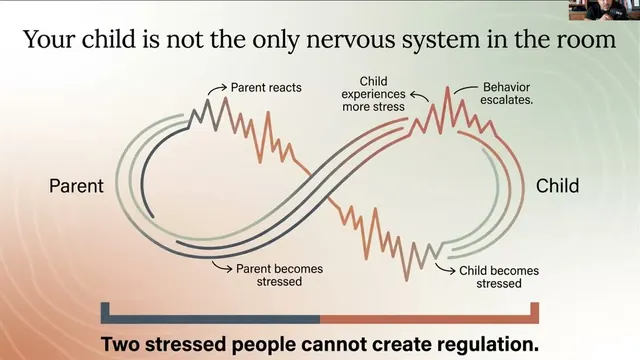
30:54The stress trap. When a child's fear meets a parent's panic, both gears lock together and spin out of control. This is called a negative feedback loop. So when the child stressed, when they're having a meltdown, then the parent gets stressed and that's what the parent wants to do. The parent wants to control. See, the child wants to control. The meltdown is the seeking to control because controlling is how we feel safe. But see, parents want to control too. And the amygdala does three things. Here's how you know when you're stressed. The amygdala wants to control, wants to suppress or wants to change the behavior. So the result is the machine breaks. It's too much tension. It's a negative feedback loop, right? More chaos, more shouting, zero connection. You cannot calm a storm while you're also a storm. Isn't that a beautiful analogy?
31:51You cannot calm a storm while you're also a storm. You know what that means? It means you have to breathe. It means in the moment, in the moment of whatever the situation is, whatever the defiance is, whatever the rolling in eyes is, talking back is, you have to breathe. And you have to let yourself know that you're not gonna die. That's how you calm your own internal storm because your blueprints are going to want. They're going to want you to control the situation. Those are your blueprints. That's how you're conditioned.
32:47And not only that, but if you've spent months doing this, not to mention some of you have spent years, then your brains are already negatively conditioned. This is why you can't just listen to a simple webinar. This is why just listening to this webinar tonight is not enough because this is a brain-based state, not just for your child, but for you too. You literally have to change your brain and unless you have repetition and emotional impact, you're gonna really struggle. And then pretty soon, because your dominant blueprints, because your old blueprints are so dominant, you're just gonna revert back to doing what you've always done. So you've gotta have the repetition and you gotta have the emotional impact. You gotta realize that you're not alone, that you don't have to do this alone, that there's support available to you and you gotta keep learning. If you want your child to do something different,
33:42you've got to be something different. This is very important. And you've got to keep doing it until that repetition locks in and starts changing your brain and their brain.
33:54So I talk about the three pathways of emotional expression. Very important because I want to give you this framework. We're gonna have to fix that cutting there. I apologize, I don't really, I'm not really, scratch, cancel, cancel, I'm not apologizing. I'm OCD when it comes to my work. And so if I don't catch it the first time, I'll be presenting and I'll catch it. I'm like, oh, we gotta fix it. And some of these slides are not in PowerPoint. You're lucky because I'll sometimes stop and fix them right in the middle of a presentation. Okay, all that aside, three pathways of emotional expression. There are attitudes, there are feelings and there are behaviors. I'm gonna put you on the path tonight. If I haven't already gotten you on the path of doing something different, I'm about to put you on the path. Here's the thing, when all of us were growing up,
34:50we could not have attitudes. When your parents said something, you rolled your eyes, you have to be puffed, it was not okay. It was a sign of disrespect, you could not do it, and it was met with intensity of energy. Bam, whether it was yelling, whether it was shaming, whether it was threatening, you roll your eyes one more time, I'll knock them in the back of your head, it was not permitted. So you learn that attitudes were not okay and then you drop the feelings. Now here's what you gotta understand. These are the three pathways of emotional expression, which means these are the three pathways through which emotion, what is emotion? Energy in motion is expressed, okay? The three pathways, energy in motion are expressed. Energy has to move. Energy that does not move stays stored. Then it becomes stagnant, then it becomes stuck, and then it becomes an ingrained pattern
35:47until it is released. This is so important. So if you can't express your attitudes, and most of us, I'd say 99% of us on this webinar tonight grew up not being able to have an attitude with our parents or with any other adult when we did not like what was asked of us or what was told to us, there was no permission. So the attitudes, the pathway of attitudes get suppressed. And then you drop the feelings. If you can't express attitudes, you sure are not gonna be able to express feelings. You can't express feelings, then that gets suppressed down to behaviors. Attitudes get suppressed, feelings get suppressed, you get down suppressed down to behaviors. Now, how many of you could freely act out and get away with it? Probably none of you. And what happens? What happens then if you can't express through behaviors? So if you can't express through attitudes,
36:42you can't express through feelings, and you can't express through behaviors, you only have two options, anger and depression. Anger and depression both being in energy, anger and depression have to come out through behaviors. Anger and depression have no other option. They have to come out through behaviors. And my contention is that if you spent six months or longer in anger, depression and behaviors, then you are living in a state of trauma. You're living in an experience of stress that is overwhelming, prolonged and unpredictable. And it has the ability and it will and can shape and change your brain and make it very, very difficult. And our society perpetuates this. And so how do you know? How do you know you're in the trauma triangle right now? Examples, cutting, diagnosis, medication,
37:39stress and isolation. So your child who shuts down all the time, residential treatment, disruptive placement, restraint, drug use, like medication, medication is drug use, drug use, which is smoking weed and drinking alcohol, suicide attempts, running away, sexual acting out and then complete shutdown and isolation. This is how you know that you're living in the trauma triangle.
38:03And I'm gonna give you an insight right now. I'm gonna give you an insight right now that I believe, I believe that has been, how's my sound? I sound okay. Yeah, you sound good on my end. Okay, good. I just happened to look at my little, my little modulator thing, get nervous for a minute. I'm gonna give you a perspective right now that can be so impactful that if you'll apply it, if you can apply it for the next 21 days, you will see some dramatic. And I'm telling you 21, I say 21 days, oh my gosh, let me just tell you, 21 days is almost impossible. Most of you won't even be able to do it for three days because it's just so difficult
38:58because your brain is already patterned. So 21 days is dang near impossible. Probably only 30% of people on here could get to 21 days, only 30%. So out of what, we have 40, 50 people on here. So we're talking about maybe 15 people out of 50 could potentially get to 21 days because it's so difficult. And then the middle 15, you know, 15, 16, 17, whatever, the middle ones probably get to like 12 days. And then the bottom of the percentage won't even get past tonight because you're already shut down in thinking about something different and understanding something different. You're staying on just as a byproduct
39:54of being conditioned for learning. But what I'll tell you is that as soon as you get stressed, everything you heard tonight is gonna go right out the window. So if you're not committed to repetition and if you're not committed to showing up and doing something different when your child gives you an opportunity, which is the absolute greatest opportunity. I'm gonna talk about that in a moment. Then it's gonna be really hard for you to shift. 21 days is difficult. You don't have to do this for 21 days. Scratch 21 days. I want you to do 21 days, but you'll get there. Do seven. If you can do this for seven days, if you can do this for the next seven days, what I'm about to tell you, it will begin completely transforming the way you see your child and it will begin completely transforming your relationship with your child. Here's what you do. Ignore the behavior. Oh, Jesus, just got overwhelmed.
40:51Why did you just have that reaction? Because you are negatively conditioned. You're conditioned from generations. Generations of a parenting belief that says an attitude is a sign of disrespect and it's not okay and it's a threat to survival and that's false. It's false. You've been led astray. You've been conditioned by people who want you to be disempowered. You've been conditioned by people who want you to have a breakdown in your core relationship with your child so they'll go and they'll cut and have to go to the hospital. They'll get diagnosed. They'll end up on medication, which is a $50 billion industry. Just depression medication alone. Antidepressants are a $50 billion industry, right? There's a vested interest in your children being sick. So no one's gonna tell you to ignore the attitude.
41:50They're just gonna keep reinforcing because they're gonna have a vested interest. I have a vested interest in you creating a healing relationship for your child. I have a vested interest in you being able to sleep better at night. I have a vested interest in you being able to laugh and struggle with your child and feel loving and I have a vested interest in you knowing that parenting doesn't stop at 18. It continues. So we gotta get it right now. We gotta start fixing it now. We don't have tomorrow to wait. We gotta start now. Ignore the attitude. Ignore the attitude. At the very most you register that the attitude is a red flag for stress. When your child is having an attitude, they're stressed, but they're only trying to transition the emotion. The energy in motion. They're only trying to adjust. Ignore it. Forget it.
42:45Don't think about it. Turn away from it. You know what the biggest struggle with that's gonna be? It's gonna be internally. It's gonna be internally. My dad is immediately on my shoulder when my 17 year old rolls her eyes or mumbles under her breath. Immediately, compelling me towards destruction and violence. But I don't do it. But I've been teaching this stuff 30 years. I've done all kinds and levels and depths of emotional work. So if that just tells you how difficult this is gonna be, but nothing worth having happens without some kind of struggle. Why is that? Because there is pain involved in growth. Why? Because your brain is having to stop pursuing
43:43one pathway and start forming a new one. That's like the gas and the brakes being applied at the same time. You're gonna do that for seven days. Ignore the attitude. And then you come to the feelings. Your child drops into the feelings. Here's the next thing I want you to do. Encourage the feelings. Encourage the feelings. Want the feelings. Want the feelings. Ask about the feelings. Inquire about the feelings. Need the feelings. Want the feelings. You know why? You know why you gotta want the feelings and need the feelings and encourage the feelings? I'm gonna tell you why. Because the feeling is the path to the healing. The feeling is the path to the healing. Feelings live in the emotional layer and before you can move something,
44:40you have to feel it. Before you can move it, you have to feel it. When your child is upset and they're in their feelings. Stop shutting them down. You don't have to take a deep breath. Remind yourself that you're okay. You're not gonna die. Everything's gonna be all right. Stop repeating the past blueprints. Oh, that's disrespect and they're being rude and they're not being grateful. Oh my gosh, all that comes from three generations ago if not further. That's not new information. That's not new knowledge. That's just you repeating on autopilot. Defiance doesn't have to be that overwhelming for you.
45:35Want the feelings. Encourage the feelings. Support the feelings because the feelings are the path to the healing. And if your child is trying to work through their pain, they have to express the feelings. And if you keep suppressing them, if you keep shutting them down, if you keep masking it, you're not giving them an opportunity to get through the healing. Now, what if they drop into the behaviors? If they drop into the behaviors, support them through the behaviors. Get through the behaviors the best way you can. Try to get through it without creating more stress. See, that's the key. I can give you 100 different ways of getting through the behavior but I focus so much on the attitudes and the feelings that I don't even get to the behaviors. And when I do get to the behaviors, I ride them like a surfer on a wave, baby.
46:30And I'm talking beach boys riding the wave of that energy, of that behavior because I want that energy to come on out and I don't want to create more of a threat. If I create more of a threat then I am exacerbating the problem. I am adding to the problem and I am not giving the energy an opportunity to express. When you try to control, when you try to suppress, when you try to change, you're not giving the energy an opportunity to be released and to move and trauma is stored energy. You piece preaching to you. Bypassing feelings inevitably fractures into severe behavioral pathology. That is the very essence of diagnosis.
47:20Put your oxygen mask on first. You've always, you've heard that. Oh my gosh, I could have used an oxygen mask on Monday. Oh, I had the most challenging flight I've had in a long time. Not because it was bumpy, but because I had to sit in an IO seat. I got rebooked, I was supposed to be in first class. I got rebooked into coach and then I got, I am a 200 and soon to be 25, 225 pound man but currently I'm a 275 pound man in an IO seat, in coach. And then we get boarded and the pilot comes on and says, ah, we have a maintenance issue and it's gonna be a 40 by the 45 minute fix. So just make yourselves comfortable. Oh, for 45 minutes. And then we have a three and a half hour flight.
48:17I was stressed, I was stressed, but I was regulating and I was kind and I had a situation with the flight attendant because of my, my dear sweet person, woman sitting next to me, needed to go to the bathroom. But I, that's another story. You gotta put your mask on first. Children cannot calm themselves down. They have to borrow your calm. Stress mixes over breath. Take three to, three to 10, slow, deep breath. I say three to 10, your calm body signals to their brain that the emergency is over. It's a signal. Your amygdala, when you can calm your amygdala, when you can calm your amygdala, you start calming their amygdala. I learned that from Daniel Goleman, 25 years of, Daniel Goleman is the author of Emotional Intelligence. He says, the calmer amygdala has the ability to soothe the more agitated amygdala,
49:13but actually it's not the amygdala. See, this is, this is before we knew all of the neuroscience. It's not the amygdala. It's the hypothalamus. The hypothalamus that releases oxytocin. Oxytocin is the brain's anti-stress hormone. So it's actually the hypothalamus that's releasing the oxytocin that's sending the vibration to your child's amygdala that's helping their brain calm down. It's very important. The greatest gift you can give a stressed out child is a calm parent. That's beautiful. Across the river, the four steps to calm. How do we guide them from fear back to safety? We cross these four stones, regulate yourself, that's your breathing. You fix the fear, change the lens. See, change the lens. You gotta start seeing stress in the fear, start seeing a baby, start seeing a regressed child. Stop focusing on the behavior. Connect first.
50:08Connection before correction. Prove they're safe before you fix the problem. And four, build a safe boundary and lead them without using threats. Ooh, you know how you get there? You know how you get to four? You go all the way back to one. You can't get to four if you're not at one. You can't get to four if you're not at one. Very important. So let's talk about that step number three. Let's talk about that step number three for a minute. Connect before you correct. When the child is panicking, they can't hear your lecture, stop talking, breathe. Breathe. When they're stressed, they're in an alarm system. They're in an alarm state. The challenge is that their stress triggers your stress. You see, we've got the more developed neuro-regulatory systems. So we have to calm our stress first in order to be able to create a vibration
51:05that allows us to start to soothe their stress. See, that's the process of co-regulation. Co-regulation, attachment is the dyadic regulation of emotion. Attachment is the dyadic regulation, the ability of two people to regulate energy together. Now, you got a parent and a child. Who is responsible for regulating their energy first? Of course, the parent is. The connection language. I see you're having a hard time. Oh, not in a sarcastic way, in an authentic way. In a heartfelt way. That's why I said you got to open your heart. You got to open your heart. I am right here. You are safe. Let's take a breath together. And then there's, I don't wanna breathe, then you breathe. You breathe. And let's talk about step four.
52:00Boundaries without the battle. Connection does not mean giving in. I need you to hear this. I did a video about permissive parenting. Well, a lot of times people hear me talking about regulated parenting as being permissive parenting. It is not permissive. Sometimes I find this to be the most powerful form of parenting. It's not permissive at all. It is actually very active parenting. It's just not active in the old school way of punishment. It's not active in the old school way of bestowing my force, my power over you by way of force. But it's very active.
52:55It's very engaged. It's very present. Just like the mom who went down the street to the neighbors to get her son. She didn't threaten him. She didn't abandon him. She stayed right there with him and she eventually got to him and she said, we're gonna be okay as she moved him away. We're gonna be okay. I've got you. I've got you. And she eventually removed him from the premises. But the only way she was able to do that is as she was able to stay regulated because as she had been stressed, he would have really went over the moon. So instead of the boundary wall, which is that if you don't stop hitting right now, you're gonna lose screen time, you gotta create the boundary bridge. I won't let you hurt people. I'm going to hold your hands to help you stop. That won't let you hurt people.
53:50No one's going to hurt you, but I'm gonna hold your hands. I'm going to hold your hands to support you because I can't let you hurt anyone. And I don't want to get hurt either. So you create the bridge. You're not threatening, you hear that? I'm not threatening you. I'm not threatening you. I'm just supporting you. I'm being with you. It becomes so important. You gotta create the boundaries without the battle.
54:16The meltdown cheat sheet. Before saying no, check yourself. Am I calm or am I rushed? You're important. Use a soft tone. Fewer words and relaxed body language. I know you want that. The answer is no. I'm right here with you. Guess what? Guess I heard it. I heard someone. Well, he's still gonna blow up. He's still gonna roll his eyes. Guess what? That's okay. That's okay. Guess what the most important part is? The most important part is that you set the limit. See, when you set the limit, that's the learning. How your child adjusts through the emotional upheaval of the limit being set is not your business. It's your responsibility,
55:12but it's not your business to feel reactive to it, to need to punish, to need to threaten, to need consequence, to need shame. It's your responsibility to see that that's their attempt to transition through the emotion and through the energy that they're having because they don't like the limit. So you set the limit, you hold the limit, and you honor that they're upset. So if the chaos starts, hit the brakes, stop talking. Take three to 10 deep breaths, stop talking. Do not match them, do not yell, do not lecture, do not threaten. Now there's an advanced part of that we could talk about, I talk about it at another time. Stay physically present and emotionally anchored. And then you have to repair. So you have the before, you have the chaos, and then you have the after, and this is the important part. You see the heart with the band-aid so important.
56:07Oftentimes we don't repair. We have stress, we have stress, which pulls us apart, but we don't have repair, which brings us back together and strengthens us. You gotta repair, you focus on the healing. Wait until the alarm bell is totally off. What happened inside and what did you need? And repairing the relationship builds trust. What healing actually looks like, yes.
56:37We have, I don't know if you wanna go back to that slide and they said if you could give an example for an older child, 12 years old roughly. You know what, I 100% give an example of a 12-year-old. Actually, that's an example I've been using pretty much throughout. But here's the first thing I want you to understand is the 12-year-old is not 12. So answer this question. If an acting out child is a stressed out child is a regressed child, if a defiant child is a stressed child, a scared child, if a defiant child is a scared child is a stressed child, is a regressed child. Means they've dropped back to their emotional age and how old is your child in that moment? So that's why I said there's so much information here. It's hard to capture all this. As soon as you say 12, he's not 12.
57:34He's an angry two-year-old. So you have to see the angry two-year-old. You have to see the stressed out two-year-old. And then you calm yourself down instead of seeing the 12-year-old, calm yourself down and see the two-year-old. See the two-year-old. And then if you really see the two-year-old, now you could have some negative conditioning because it may be getting hit because of things being thrown, because it being threatened, I understand all that. So you got some negative conditioning that your brain goes into hyper alert. So you're gonna have to figure out how to override that. You're gonna have to condition yourself to do some breathing because you're gonna have to calm yourself down to see the two-year-old. So when you calm yourself down to see the two-year-old and let's say the chaos starts. So the 12-year-old is on the porch and he's cussing at the other kids and he's cussing at the parents of the home. He's on their porch. He won't leave. He doesn't wanna leave.
58:29The mom coming up and threatening and yelling and lecturing does not help the situation. It just makes it worse. So she has to stop talking and she has to start breathing and she has to calm herself down. And in this instance, she reached out for support. I love it when parents reach out for support. This is one of our parents in our wraparound program here in Northern California. I know we have people from all over the world on our talk tonight. But she said, she told me exactly what was going on. And I kept a calm voice. I said, okay. See, I have to be calm in order to help her be calm. So she told me about the situation and I said, okay, let's just slow down. I said, maybe he'll talk to me.
59:24He didn't want to talk. He wasn't hearing anything. I said, that's okay, that's okay. And then finally I said, what I need you to do is I need you to go set beside him. I need you to keep yourself calm. I need you telling me he's okay. And then I need you to start moving him along and telling him we're gonna be okay. You're gonna have to move him along and tell him we're gonna be okay. And that's exactly what she did. So exactly what she did. And I think it was probably within about five minutes she had trans, it was probably less than that because she called me back because then it moved into another situation with his brother and then she was just afraid. She was afraid to drive. You know, these things happen. But that's the dynamic. That's the dynamic. And so you have to stay physically present and emotionally anchored. And sometimes you gotta have support in that.
1:00:20Sometimes you gotta have support. That's what a community is for. That's why it's important for you to realize that you're not alone. So there can be so many different examples of that.
1:00:31So the goal is not perfect obedience every time. You gotta hear that. It's not a home without zero meltdowns. That's not the goal because the feeling is the pathway to the healing. I actually want the child to melt down because every time the child melts down and I'm able to respond in a positive way. I'm able to hold, I think about the gladiators, hold. I think about a Braveheart, hold, hold. All this energy and all this tension is coming. You're holding space, holding space. Every time you hold space through a chaotic moment your brain stores that and that's what your brain returns to the next time. Bruce Perry says the brain always returns to the way the event was handled the last time.
1:01:28That's how I know healing is through the feeling because when your child can work through the feelings and you can support them, that's the healing path. The goal is to create a feeling of safety, building deep trust over time and helping the nervous system grow stronger. Healing happens through repetition. What did I say? The brain changes in two ways. Repetition and emotional impact. So repetition is the day to day to day to day to day. The repetition is the learning, the learning, the learning. The repetition is the support to support. The repetition is being in the community of people doing something different. The repetition is walking along someone to support you and then the emotional impact. The emotional impact is happening in the moment. The emotional impact is happening in the midst of the behaviors and everything about our mental health system
1:02:23is about suppressing and controlling the behaviors instead of supporting children through them. I just said two completely diametrically opposed things. A new way to see. Your child is not giving you a hard time. Your child is having a hard time. The chaos can change. The relationship can heal. When we stop asking what is wrong with this child and start asking what happened to this child, healing begins. Love is the only force powerful enough to rewire the brain. Love is the most powerful healing force in the universe. Every day counts. Every day counts. Don't stop here. Don't stop tonight. When you get this recording, please listen to it three times, four times, five times.
1:03:20Read the book. If you don't have Fear to Love, get From Fear to Love. If you need more support, please get more support. Don't do this by yourself because this is like climbing the Himalayas. If we take this whole group right now tonight and we're gonna climb the Himalayas, there's a third of us that aren't even gonna do anything. We're not even gonna try. But you know what happens when you don't try? Nothing changes. When you don't try, nothing changes. That means everything you've been doing, which is conditioning and programming your child's brain is gonna continue happening. Okay, that's almost the worst. But then there's a portion of us that we're gonna try climbing the Himalayas of healing all by ourselves. So you're gonna maybe watch the webinar again. You're gonna maybe read a book. You're gonna try to do it by yourself.
1:04:15And it's the Himalayas of healing. And what's gonna happen? If you go out there and you try to climb the Himalayas of healing all by yourself, you're probably gonna get to the first base camp and you're gonna freeze to death. And if you don't, you're gonna turn around and you're gonna go back. So you're gonna put up a noble effort, but you're gonna try and it's gonna be overwhelming. You're gonna turn around and go back. But then there's another percentage of us on this webinar tonight who know something very important. They know the benefit of an emotional Sherpa. They know that if they're gonna climb the Himalayas, they need a Sherpa, they need a guide. The Himalayas of healing requires an emotional Sherpa because this is not a cognitive thing to figure out. This is an emotional thing to understand.
1:05:12I am an emotional Sherpa. I have climbed the Himalayas of healing a thousand times. If you wanna know how to get to base camp and then you wanna know all the potholes from here forward, then let me walk beside you. Let me be your emotional Sherpa. Here's what I want you to do. To find the exact path that's right for your family, we have an assessment. It's an AI-powered assessment. You go to feartolove.com and this is for professionals as well. You go to feartolove.com. Now, probably what's gonna happen, I'm anticipating is that there gonna be 20 or 30, 40 of you go and start taking this assessment and it's gonna probably overwhelm my poor little Bryan Post AI.
1:06:08But bear with it. It's gonna ask you some really simple questions. Okay? You'll see it, it's gonna pop up. You know, even on your phone. You go to feartolove.com, it's gonna pop up. We'll chat, we'll chat windows, start having a chat. And then if you answer the questions, it's gonna give you a personalized map. A personalized map. For me, your emotional Sherpa on what path is gonna be best for you to accomplish the goals that you want. And I'd love to hear from each and every one of you. God bless you, thank you for joining me. That's the end of our presentation. Remember in any given situation, we always have two choices. We can continue to react from our same blueprints of stress and fear and overwhelm, where we can stop, we can slow down, we can take three to 10 deep breaths
1:07:05and we can choose love. And I hope you'll choose love.
1:07:09Okay, Jasmine, we can open it up for questions. feartolove.com, go answer those simple questions. It's gonna give you a personalized map and we'll follow up with those that need to be followed up with. And for those who don't, you're gonna get exactly a path that's mapped out right for you. Okay, do we have any questions, Jazzy? What are we looking at? It's eight, 10. I got 20 minutes and then I've got a dinner I've got to get to. No questions so far. But as far as the 12 year old, they were talking about, they can't hold to their hands. He's too big. So it's kind of more, I guess when you were talking about holding their hands and comforting them. Okay, yes. Okay, no, that's perfect. Number one, you can hold a 12 year old's hand. See, you're not looking at a 12 year old.
1:08:05You're talking about a two year old. The mom, not just the mom, even me too of the 12 year old that I was just talking about, I've held his hand. He's laid over on my shoulder. I put my arm around him. He's giving me big old full body hugs. Tells me he loves me because emotionally he's not 12. He's the sweetest pie until he's stressed out. But you can't hold your 12 year old's hand. Don't limit yourself. See, those are probably blueprints. But in the moment, when the child's escalated, get quiet. Breathe, slow down. See the two year old, say to the two year old, what do you need? What am I missing? What can I do? And then they're probably gonna scream, nothing, leave me alone. Shut up. You're annoying me. You're annoying me. And then you get more quiet. And then you wait.
1:09:04And then you're gonna be surprised because then they're gonna calm down. They might even go run to their room, slam the door. Fantastic. Wait. Wait, give it space. Give their brain an opportunity to relax a little bit, not be so much on the defensive. Now here's what you gotta understand about opposition. An oppositional defiant child is a scared child. If you make a request for a child to do something, give them some space. Give them some space. Slow down. See, we have all these negative blueprints that a child should do, what I say to do, when I tell you to do it. Guess what? You think that you are training your child to prevent a future from happening when in fact you end up reinforcing, you end up reinforcing what you fear may happen for your child
1:10:00by not creating the space now for their brain to relax when it comes time to transition. Give them space, come back. Connect. Be supportive, be understanding. But the main thing is to breathe. Calm yourself down. Calm yourself down. What else you got, Jazzy?
1:10:25All right, how do you help a toddler who is stressed and is constantly being subjected to the cause of their trauma through court orders? It feels like we are stuck in a feedback loop with no tools to help. So painful, it is so painful. It is an absolute failure of the system. Let me tell you. But here's what I also wanna tell you is that you do have tools to help. Number one, it takes high levels of stress, 36 hours. High levels of cortisol, 36 hours to clear the brain and the body. So after a visitation, oh my gosh, this is such a failure of the courts. After a visitation, expect 36 hours of cortisol, which means 36 hours of a stressed out child,
1:11:23which means potentially 36 hours of behavior. Now, if you expect it, then what you realize and what you remember after this webinar is an acting out child is a stressed out child is a regressed child. So the visitation is causing the child to regress back to the time before they came to you. Now, here's the opportunity. The opportunity is that when you are calming yourself down and when you're connected and when you're grieving for your child, you're grieving for all the things. You know, even though he sees, even though he sees potentially the people who created the trauma in his life, his biological parents, there's still grief connected to that. There's still loss connected to that. So you have to see that.
1:12:18You have to engage that with your heart and you have to engage healing and grieving for your baby. Even if your baby is five or 10 or 15, you have to engage that healing for your baby. And when you do that, it is going to allow you to find a deep reservoir of healing energy and connection for your child. So what becomes the stressful events actually have opportunities for great healing? And then you start to be preemptive. Before the day before you got to have the visit, you just tell your child, hey, I know you're excited or I know you're worried and I know that creates a lot of stress but we're gonna be okay and we're gonna come home. Everything's gonna work out. I love you, I support you.
1:13:13After we're done, we'll go have some food, we'll go to the park. You start being preventative, setting their system up to be able to expect and then when it's over, connect to the baby, connect to the regressed child and be willing to hold that space for the next 36 hours. So I'm talking about nothing but nurturing, nothing but affection, nothing but loving on him. Man, if you do that, oh my gosh, it's gonna be so powerful but let me tell you, I have written many letters, many letters over my career to judges advocating for reduced visitation, if not complete ceasing of visitation, especially if the children are having really strong reactions to it because the only person that's making it hard on other than the children are the parents who are caring for them.
1:14:12Hope that helps. Okay, Jazzy, anything else? No, we're good. All right, God bless everyone. Thank you so much for joining me. Be on the lookout. We're gonna be doing these every month. Now let me also tell you, complete that feartolove.com, complete that assessment but I also wanna encourage you to go to Bondify.ai, B-O-N-D-I-F-Y-dot-A-I. That's my AI-powered parent support app. It is the support that you needed in that moment and everyone knows what that moment is. You can literally ask it questions in the moment. It'll give you support. There are resources there. Now that's a community that I'm pretty soon between myself and my coaches, my Fear to Love coaches. We're gonna be having weekly live Q&As. That is our community.
1:15:07More and more, everything that I do is gonna be through Bondify. So get yourself on Bondify. You go in your Apple store, go to your market and download it, it's absolutely free and you'll get these daily messages from love which I love, I love them, I love to read them. That's how you can stay connected with us and then obviously through Fear to Love and then do the assessment. If we can support you, hands on in some other ways, the assessment's gonna tell you, we can support you. If you're in Northern or Central California and you're at risk adoptive family, we can support you. If you're in other parts of the country or internationally, I have certified Fear to Love coaches. We can support you, but it all starts through feartolove.com. Do the assessment and we'll follow up with you. You guys take care, God bless. We'll see you again soon.
Keep going on this topic
 Webinar77 min
Adoption Parenting with Love and Limits
Big behaviors & feelings · Sep 2026
Watch the recording Webinar85 min
The Angry Child's Hidden Story
Big behaviors & feelings · Jun 2026
Watch the recording Webinar79 min
Aggression in Adopted Children
Big behaviors & feelings · Jan 2026
Watch the recording