The Unique Needs of Adoptive and Foster Children
A trauma-informed webinar for caregivers of children shaped by attachment loss and adversity.
Presenter: Jeanette YoffeRecorded May 202691 minEnglish · Captions (CC)
What you'll learn
- The 12 unique needs of foster and adoptive children, from attachment, trauma and identity to the fear of being given back. As Jeanette Yoffe puts it, emotions are hysterical because they are historical.
- How the healthy attachment cycle builds trust, and what a child with an avoidant, anxious-ambivalent or disorganized attachment style needs from you, told from the child's point of view.
- Why a child who has lived through trauma may be at least two years younger emotionally, and how to stop assuming negative motives: not “what's wrong with you?” but “what happened to you?”
- Connection before correction: be a feeling detective, mind the seven nonverbal cues (yours and your child's) and use Daniel Hughes's PACE (playfulness, acceptance, curiosity and empathy).
- Why shame keeps a child from apologizing, and the shame sandwich, a way of talking that tells your child: “You are not the mistake. The mistake is the mistake.”
- Hands-on tools for grief and unanswered questions (a question box, a sad bag, a grief mailbox and a comfy doll), and why leaning into your child's loss brings you closer.
Transcript Show full transcript +
0:00and thank you everyone for joining me today for the unique needs of foster and adoptive children. So as you can see we have the closed captions on so you can hear me and read the information. It's a great way to learn and so if you have any questions please put them in the chat and I will get to them at the end. Okay so let's begin the unique needs of foster and adoptive children. There are 12 unique needs and there's a phrase in adoption. We want to adopt all the needs, not just some of the needs. We understand the needs of children who've experienced trauma. They have a lot of vulnerabilities and strengths. So these are their needs. Number one, there are attachment and relationship challenges. Many foster and adoptive children struggle with attachment. Whether it's due to early neglect abuse or multiple placements in the first five
1:01years of life are crucial. They may exhibit difficulty trusting caregivers or forming healthy relationships and there could be reactive attachment patterns such as avoidance or clinginess which are common. So part of this training I'm going to teach you how to be attachment responsive. Number two, there's trauma, early adverse experiences and there's loss. Adoption is formed through loss and we need to lean into that and embrace that. Nearly all foster children have experienced some form of trauma. Neglect, abuse or exposure to domestic violence, homelessness. Even infants experience the loss of their primary caregiver and that's considered a separation trauma. Any baby that is separated from their mother at birth is considered traumatic for any baby and the processing of that is a lifelong processing
2:03and as you heard in my bio, I am also an adult adoptee and I was raised in foster care. I'm still dealing with pieces and parts of my early life experience and it's a part of our journey. You can't fix all these parts, you can lean in and meet the needs of these parts. So grief over losing birth parents, siblings, culture, race, familiarity can persist even after adoption and often the questions of what happened to a child peaks in adolescence. They really start questioning their identity. So the third unique need is identity and belonging. Adopted children especially those in transracial, transcultural or international adoption do struggle with identity. Who am I, where am I from and where do I belong are the questions.
3:04They often wonder about their biological origins, their personal history and the question why were they placed in care to begin with. The big question is why was I adopted for kids? Foster children may feel like they don't belong anywhere leading to self-esteem issues. Number four, emotional regulation and behavior. Many foster and adoptive children have difficulty managing emotions, particularly anger, fear and sadness. They may exhibit aggression. Typically boys exhibit aggression because they are experiencing depression. They can be withdrawn. It's really hard for kids to put words to an early life experience so they will retreat within themselves. They can be hyper vigilant, scanning the environment, ensuring their safety, ensuring they're not going to move again or they can have extreme
4:05emotional outbursts. Some struggle with impulse control stemming from that early trauma where they did not have their needs met early in life. They don't know how to get their needs met by their new caregivers because of inconsistent caregiving. Five, trust and safety issues. These children often have an internalized belief that the world is unsafe. Of course if the rug was pulled out right on my birthday, birthdays are going to bring up all these feelings and are you really going to stay with me or are you going to do the same? They may be hyper vigilant and overly dependent, independent or struggle to ask for help. They need a lot of consistency, patience, predictable routines. They need to know what's going to happen before it happens. It's in a parent's best interest to do what's called front loading. Tell the child what's going to
5:04happen at the beginning, middle and end so they know what's going to happen and they trust what's going to happen to rebuild their sense of safety. Six, cognitive and learning challenges. Some children experience developmental delays due to prenatal exposure to substance abuse, malnutrition or neglect. They may struggle with executive functioning skills such as planning, organization and focus. That's why they need a lot of time in coaching, parenting, learning. There can be learning difficulties including language delays and lower academic performance are common. Seven, sensory processing differences. Many foster and adoptive children have sensory sensitivities. Think of the five senses due to early neglect or trauma. This is a fact about trauma. Trauma gets absorbed through the senses.
6:02And one of the things that I asked children and I'm a psychotherapist, I work with children, I supervise therapists working with children who experience trauma is asking a child and being aware what is their heightened sense. Which sense gets them overwhelmed the fastest? Is it looking at things? Is it listening to things? Is it touch? Is it taste and is it smell? That then you will know that's the sense that needs more attunement, more nurturing or softness. So they may overreact or underreact to touch sound smells or textures. So sensory based interventions are crucial such as using weighted blankets. Sensory swings or fidget tools can really help from a body up perspective calm the sensory overload. Eight, fear of rejection and abandonment.
7:04Even after adoption, children may fear being given back or rejected. I was adopted at the age of seven and a half. And for two years, I kept asking my mother, when are you going to give me away? I didn't believe I was adopted. Adoption is a very abstract term for kids. They don't understand it. They don't understand the cause and effect. And that's why we need to tell them their story. And I'm going to give you some pointers about that. They might test boundaries to see if caregivers will meet them. They need reassurance, unconditional support and trauma informed parenting to help reduce this fear. Nine, social and peer challenges. They will have difficulty with peer relationships due to a lack of social skills or mistrust. There's what's called a push pull in relationship. I'm going to bring you close, but only so close. And there's that wall.
8:04That's the fear. They may have trouble interpreting social cues or struggle with appropriate boundaries. They will need help navigating friendships and learning healthy social interactions. Ten, medical and developmental needs. There are higher rates of chronic chronic medical conditions due to prenatal drug or alcohol exposure or drug exposure and malnutrition. They will need a comprehensive medical, dental and mental healthcare evaluation. Early intervention services may be necessary for developmental support. Eleven, there's legal and systemic complexities. Many foster children experience multiple placements which disrupt their stability. They're navigating legal processes such as parental rights termination, guardianship and adoption can be confusing. They meet social workers, multiple
9:03therapists, advocates play a crucial role in supporting children through these transitions. But they also attach to these workers and then they lose them. So there's a lot of grief and loss for this population. Twelve, there is a need for permanency and stability. And that's why we're here. We are providing permanency through adoption. The lack of permanency is one of the most significant stressors for foster children. Frequent moves lead to emotional instability and difficulty forming lasting relationships. Even after adoption, like my story, the fear of loss persists. So I say this phrase a lot to parents of foster youth and adoptees emotions are hysterical, right? They're very big because they are historical. They have early adverse childhood experiences that we must take into account.
10:03Babies' bodies remember the experience. So I'm going to teach you how to be attachment responsive. There's attachment responsive. There's many layers to becoming an adoptive parent and becoming a therapeutic parent. You need to be attachment responsive, trauma responsive and grief and loss responsive. And you don't have to. I tell you, you get to. You will help your child heal through this journey. So this is a healthy attachment cycle. Some of us may have had an early childhood attachment cycle that's healthy and some of us may have not. So this is how it works. Number one, the infant has needs. Number two, they express these needs through crying, facial expressions, arousal, that hysterical emotion. Three, the parent responds and meets the baby's needs. That's gratification. The parent leans in, they see the child's
11:00upset, they hold them, they provide relief. Number four, relaxation. This is how trust develops. And this is truly the goal for parents to meet the needs, even if, and the phrase is, there's undesirable behavior. That's a part of their experience that we need to embrace and accept because it may be challenging for you. It's challenging for them too. So this is a picture of the circle of trust. It's how to help your child feel safe when your own world is turned upside down. So you are the kind hands, kind face, safe hands. Mom and dad, all these feelings are too big for me. Sometimes I might feel okay, but sometimes I don't. When I feel sad or scared, I might cling or get real quiet or act out of control.
11:56At those times I'm telling you, I don't know what to do with how I'm feeling. I'm really saying please help me. I need you because I'm often still scared and confused. You may not realize how much you help me just by being with me. So I need you to talk with other adults and let them help you trust in the future, joining support groups, having a listening partner, someone who understands the experience. Be in charge, be kind, give me predictable daily routines with front loading. Sit down with me often. Offer something reassuring and let me know it's still okay to be afraid. It's accepting these uncomfortable feelings. It's really being comfortable with the discomfort is healing because it's actually leaning into any discomfort, uncomfortable feeling. Well, actually the irony is it shrinks the feeling. It softens
12:55the feeling. So when there's a secure attachment, and this is from the child's point of view, I do become distressed by separation from my mom, my dad. However, I can leave you and I happily greet you upon your return. I can direct my anger at you because I know you're safe, we're safe, and I know you're not going anywhere. I can be settled by your attempts to soothe me. I know I'm lovable and worthy. Now you can discipline me because I trust and understand our relationship is secure and you're teaching me how to be the best me. It's a healthy attachment style and I want you to think of your child as we're going through these styles. So this is what this circle of security looks like. The child goes out into the world. I need you to support my exploration. I need you to watch me, help me, enjoy with me, delight in me, and very important for adoptees. Welcome my coming back to you. Celebrate, protect me,
13:54comfort me, delight in me, and organize my feelings, even if there was an unpleasant experience. So these are what's called good parent messages. In early life, zero to five, we need to hear these messages over and over thousands of times from our caregivers. School age, we need to hear all of these statements thousands of times. Teenagers need to hear these statements thousands of times. And if you are trauma informed and you recognize that you do need to parent your child from their emotional and psychological age, if you have a 13 year old and when you witness her hysterical behavior, you recognize she's not 13, she's really three, because that's when
14:49her trauma occurred, then you're going to go to the early life good parenting messages and make sure you're repeating these over and over so developmentally you can get her back on track. So this is great to print out, put on your fridge, take a screenshot right now, and remind yourself that you do need to be trauma informed and this is attachment informed.
15:16So here's the abuse and trauma attachment cycle. The infant has needs, they express these needs, crying, facial expressions, emotions. The parent does not respond and leave these needs. And that becomes an abandonment. That's why a lot of adopted kids feel, have a high sensitivity to any perceived sense of abandonment. It could be a look that someone gives them and they feel abandoned and that's the attachment. Then the child, the baby or child turning upon their developmental age feels fear, confusion, anger, insecurity, that mistrust, and they don't know how to cue their caregiver. So one of the first styles in attachment is they may become avoidant. I'm going to be really independent and self reliant upon our separation. I'm going to avoid turning to you for help or intimacy. I'm going to minimize your importance to me. I'm going to be reluctant
16:16to rely on others and I'm going to put up those walls. I am indifferent to your leaving and returning. I'm not paying attention. I have an implicit claim of strength and independence. To get close to you will be rejected. To truly separate is to be rejected. So I'm not even going to attempt to have a relationship. I'm going to avoid. And this is a vulnerability for these kids. Typically kids who have avoidant are kids who've been in multiple placements and they act like they don't care, but deep down I swear it kills them and they're harboring and binding so much anxiety because they really, truly want to be in relationship with their parents. They just don't know how. So this is what this looks like. There's the secure base, the parent and the child is way outside of that circle of security. They act like they
17:16need to explore or be distant. They don't know how to cue the parent, how to get their needs met, that makes the parent uncomfortable. The child's uncomfortable, but the child wants to be welcomed back. It's very confusing what's going on internally for these kids. So how do you parent an avoidant attachment? You need, so child's point of view, I need your support of attuning, being curious about what's happening with me and positive experience of me. Can you look at me a lot like gazing? Can you show me you love me with and without words? Can you have empathy for all my feelings? Can you take turns with me? It's not all about what you want. Let's negotiate. Let's talk about this. These kids need a lot of conversations. Can you match my affect? So I know you hear me and I exist. Can you repeat
18:14my words a lot? So I know you get another attachment style. The child may be anxious or ambivalent and that is child's point of view. I do become distressed and anxious by our separation. I fear I will lose our relationship. So I become very clingy. I worry about being disappointed or abandoned. I can be either passively overwhelmed or angrily preoccupied with my toys or activities. They have an up and down behavioral episodes. I rely on you to make all my choices and I minimize my need to be self-reliant. You just do everything because I can't even deal and so anxious and ambivalent. But to be close to you feels too smothering and to be separate feels abandoning. I'm just screwed either way. So these kids have also that inner conflict. They want to be close to their parent and they want to go out in the world.
19:12I act like I need comfort and our protection. That makes us uncomfortable because the parent doesn't recognize my attachment style. I miscue you. I don't know how to get my needs met and I need support in this exploration. So parenting a child with anxious and ambivalence, I need you in supporting me and help me take charge. Much different than avoidant. Help me be a leader. Give me clarity. Explain everything to me and let me know the purpose of what's going to happen and that I have purpose. A lot of these kids because of that early feeling of abandoning, of not remaining with their birth families feel like it's their fault and they also feel like they don't have impact because had they had impact, their birth mothers would not have relinquished them to adoption. That's what they believe and lately this was my fault. So they
20:11need we need to take a lot of interest in their exploration of the world. Even if it's crazy, it doesn't make sense. Like I want to get a whale and get a pool in the backyard. Wow, tell me more about that. They're just exploring their world. We want to honor our separate experiences. Know that they have a different way of thinking. Be clear with me. Explain things very concretely and make sure I get it. What you are saying so we are on the same page. And the last attachment style is disorganized and these children are very difficult to parent. 80% of children who are abused will develop disorganized attachment as per the adverse childhood experiences study. Child's point of view, I become very fearful when you are not here for me. These are kids if you're literally five minutes late picking them up from school, they think you're
21:10gone. They think you're not coming back and they go into a very heightened state of arousal fear. And when I reach for you, you're not there. They seek and avoid closeness. I feel helpless. I keep calling for you. You scare me over and over. You don't know how to help me either because you're helpless too. It triggers disorganization in the parent. So whatever the child's attachment style, it's going to trigger those feelings within you. So be aware. I will do this all on my own. I'm not going to rely on you because no one will ever understand me. I cannot share what I'm feeling and thinking with anyone because I will only feel more helpless. That's why a lot of kids who enter therapy, it's not that they won't, they can't talk about their feelings yet. It's very overwhelming. We don't want to force,
22:05coerce a child to talk about their feelings. We need to meet them where they are. I fluctuate between expressive and distant at the same time. The source of my support is also feels like the source of my danger, meaning you, the parent, they don't know how to come to you and get their needs met. I long for love and I reject intimacy. And so these kids, this is what it looks like. They're literally in an island within themselves. I need you, but you are so frightened or frightening to me. And this is their perception that I have no one to turn to and I don't know what to do. And there's no hands. You see, they're not relying on any caregiver. So for disorganized, I need your support. Lots of structure. Please be consistent on time. Don't lose it on me. Be available and please work hard and understand what's driving my
23:04behaviors. I'm just so scared you will do the same as my family of origin. Abandon me. Please attend to my feelings. I need you to be so kind and smooth in your affect. I need you to recognize rhythms and join with my rhythm. Focus on helping me complete my tasks
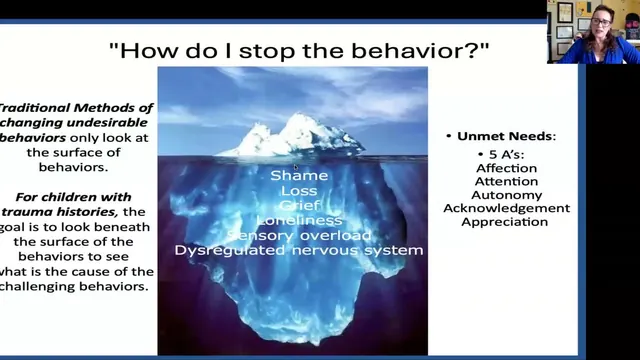
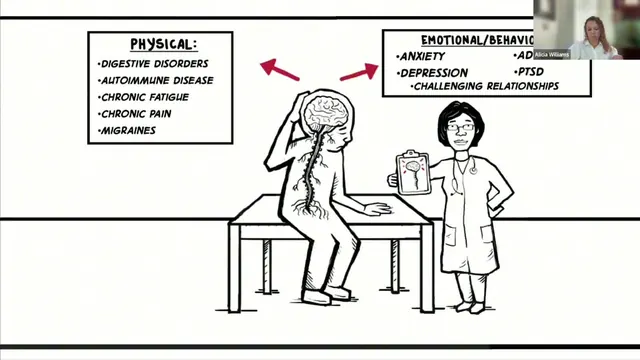
23:25and support me in completing. So challenging behavior is a symptom of trauma. Babies are traumatized. Even separation of birth. It is considered a trauma. So we need to be trauma responsive. So the traumatized client may have at least a two-year emotional and psychological delay. So you may be parenting a 10-year-old, but you really realize when they're having their big hysterical feelings is not really 10. It's maybe five, six, seven. There's at least a two-year delay. So the paradigm shift is putting on a different set of glasses. When you see your child differently, you will see a different child. And that's why these kids have unique needs. So the traditional model is we're looking at kids and going,
24:20why can't they just behave? Why won't they behave? Right? We're questioning them. We need to reframe that question. They can't behave like other kids their age. They can't. And I like to add the word yet. With therapeutic parenting, we can help them get developmentally on track. And when you're looking at your child, why won't they behave? This is when parents get stuck in assuming negative motives behind behavior. If you're questioning what's wrong with them, he's just trying to manipulate me. He just wants attention. Well, guess what? He is trying to manipulate you because that's all he knows how. He does need attention. It's not that he wants attention. He needs attention. He thinks he knows everything. He needs to control everything outside of his life externally to regain a sense of control internally. He's just trying to get
25:22away with something. That he's trying to regain a sense of control and agency. He's not trying. If we have a parent saying he's not trying and not recognizing, it's not that he's not trying. What's driving that behavior? He's avoidant. He's afraid to try. He's lazy. These are negative assumptions. And if you're stuck in this negative assumption, it's going to be really, really hard for you to have empathy for your child. He just wants to make me mad. And then it becomes about the parent and not the child. So if you're having these feelings, it's really important to talk to someone, talk to other parents, join support groups, even go in your own therapy. It makes you a better parent. I'm a parent. I'm a psychotherapist. I go to therapy. It makes me a better therapist. So if this is the case and you're feeling stuck,
26:20you need to manage your own anger. When a parent perceives a negative motive in their child, they are making that motive more prominent, even creating it when it was not present before they perceived it. It's the parent that says, stop being disrespectful. We've just planted a seed, be disrespectful. And guess what? A child who's disorganized and avoidant is going to do. I'm going to show you disrespectful. Thank you for giving me that lead. So we often create more issues when we assume negative motives. So we really want to put on that trauma lens, stop focusing on what's wrong with you and reframe to, wow, wow, what happened to you? That you need to protect, avoid, and control the world around you. We really need to understand what happened to them in their early, early life because the kid who has experienced trauma is not
27:20trying to push your buttons. They are having a healthy response to an unhealthy internal
27:27threat. Please do not take these behaviors personally. So in trauma responsive parenting, it's using connection first, connecting with your child, attuning based on their attachment style before correcting so that you can guide your child in a positive manner without sacrificing their autonomy and individuality, accept all behavior is a form of a communication of one of those unmet needs. We want to know the meaning of the behavior before knowing how best to respond to it. So it's your, I often say you're being a sensory detective, a feeling detective, you're exploring constantly, you're getting to know what's going on inside for your child. So you're exploring the meaning of their thoughts, feelings, wishes, intentions, perceptions, memories associated with the behavior and the child's response and paying attention
28:29continuously guides the parent to choose to modify a tune, fine tune, or even completely change a prior decision because as you're going through this training with me this morning, you may realize, well, I did not put that lens on and now I am going to see my child different. So attachment and communication, family is about we, if we say to a child, you're the problem, you need to fix this, it puts the child in a very difficult place and makes them more anxious, more ambivalent to connect because they feel that they're targeted and that they are the problem and they're the only ones that can fix the behavior. And that's not the case, children need their parents. So it's about we using we, us. Let's
29:25figure this out together. I get it. Every day school is frustrating. Let's talk about this. Let's problem solve what to do different. So they need a lot of time in, a lot of sitting down and talking. We're going to figure this out together. So you're focusing on the problem together with the relationship, lectures with this population, not effective because they are actually educating the child to comply with authority. This is the way it goes rather than developing their own meaning and understanding about an issue. And with these kids, it's like giving a prosecuting attorney more information to work with. So I always say, keep it short and sweet. K-I-S-S, please do storytelling when explaining a limit, when explaining front loading, what's going to happen? This approach storytelling actually changes your tone of voice too,
30:22as opposed to telling or interrogating or trying to convince. It actually conveys an attitude of acceptance of the listener rather than evaluation or criticism and encourages
30:36a non-defensive response in your child. So it's in your best interests. Another technique to establish safety. A child in stress reads our bodies before they can attune to our words. And that's the right brain. 80 to 90 percent of communication is non-verbal. There's something called mirror neurons. If you go out to lunch with a friend and you go into the lunch and you're happy and you're feeling good and your friend is depressed, by the end of that lunch, you will be depressed. It's called mirror neurons. It's your right brain attuning and picking up that communication, that non-verbal communication. So the seven non-verbal cues, I encourage you to memorize them. You need to be aware of what you're communicating through your seven non-verbal cues and pay attention to your child's seven non-verbal cues. So number one is eye contact. The way you're
31:35looking at your child, you want a soft gaze, not an accusatory look. Even if there's undesirable behaviors, we're still staying curious. Your child's eye contact will indicate if they're stressed, if they're about to flip their lid, if they're about to have a hysterical behavior will help you attune your facial expression. Some parents aren't aware they hold their face very tense, which can overwhelm children. So be curious, open up your face when you're communicating with your child is an attachment, attuned, responsive way of establishing safety. Tone of voice and be aware of your child's facial expressions. Tone of voice. They say when you're curious, curiosity again, like storytelling invites the
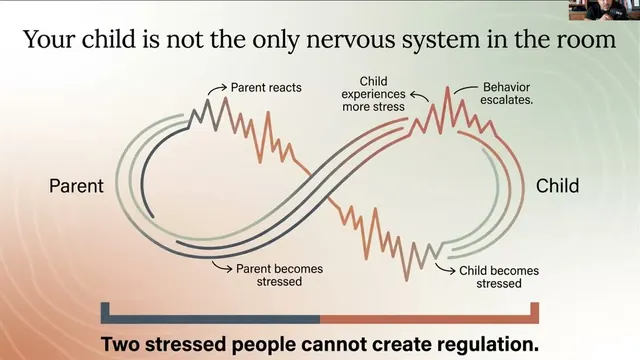
32:30listener and it's soothing, it's soft. So practice, even out loud, practice with yourself like huh or ask your partner, how do I sound? Am I curious? What is my tone of voice? Is it feel safe and be aware of your child's tone of voice, your posture, how you're holding your body? I had a father come to therapy all the time. He'd cross his arms and sit there, very upset and frustrated. Why won't she talk? Why won't she share her feelings? Well, his whole posture was communicating to her. I'm not in touch with my feelings. I'm turned off. I'm upset. I'm not safe. So I was, I helped him open up your posture. Be vulnerable. Your tone sets the tone. You're the thermostat. If you're crossed, she will be crossed. Hand gestures, how you're communicating. Do you point a lot? That can cause distress in a child. Be aware of your
33:31gestures. Be aware of your child's gestures. They may begin to become tense and clench their fists and you know it's time to go in and talk to them. See how they're doing. Be curious and timing how fast or slow you respond and the intensity of your response. So if your child starts to get upset and you start getting upset, that's only going to add more fuel to the fire. So be aware of how you're responding. Work on grounding your nervous system. So OWL is observed. Watch and listen. Your child's seven nonverbal cues and always track your
34:13nonverbal cues. Okay. So this is another technique. It's called PACE and it's such a wonderful technique and when parents apply this to any undesirable behavior, all behaviors, it's going to help you self-organize. So it's an acronym, P-A-C-E, and I didn't develop this. Daniel Hughes, who's a serious psychologist in the field of attachment and trauma developed this and has been teaching this for years. So you don't have to go in this order. You ask yourself when you're seeing behaviors, which one am I going to do? And you can do a combination. Am I going to do P-A-C-E right now? Be playful. Kids get stuck in behaviors. So humor is really important because it can create quality of lightness and openness. And I want you to put these
35:13techniques you're learning into reality. I want you to try it and give yourself the opportunity to see that it does work for you. It takes 30 days to change a paradigm. So doing any of these techniques for 30 days and see the difference in the way you respond and the way your child responds to you. Laughter builds memories of unconditional acceptance. Important for parents to laugh at themselves and admit their mistakes openly. It's okay to apologize to your child that actually teaches them without telling them, this is how we repair. And I'll tell you when a parent apologizes, the child is usually surprised. You're apologizing to me because it's respect. And the child then begins to imitate that behavior. And they tend to also come
36:09back and apologize to parents. So it's in your best interest to do so. Humor can shift a stuck triangle. So playfulness, acceptance. Acceptance has nothing to do with permissiveness of behavior. Behavior always remains to be evaluated. Parents will continue to set limits and direct behavior by focusing their teaching on the behavior, not on the child. So it's, I love you. I don't love it when you kick the dog. That's separating the child 100%. I love you. I don't love it when you and you could do playfulness and acceptance when you throw yourself on it. I don't love that. Right. So we're placing the emphasis on the behavior, not the child. And we're understanding that the child's behavior represents the child's best effort at that time. They are doing the best that they could. If you were not able to see that, then we're assuming
37:09negative motives. The parent may disagree with the choice while at the same time accepting the intention behind the choice. Well, mom, I was just so angry. That's why I threw myself on you. Okay. Thank you for telling me that. And we want to learn other ways of releasing our anger rather than throwing cell phones at people. Can we talk about that? So now having a conversation. See is curiosity. When you see a behavior having a non-judgmental, not-knowing stance that requires a parent to inquire about the child's inner life that led to the behavior. You come home, you see syrup all over the kitchen floor. Right. What's your first instinct to yell? Right. That's normal. What happened here? This is going to be a shift to go, oh, I'm doing PACE now. I'm going to be curious and it's going to be an adjustment. It will be an
38:08adjustment. A child needs to feel safe that their inner life will not be criticized when a parent yells the child feels criticized. And if they do, the child is going to hide their motives, not be able to modify their behavior and not tell you what actually happened with the syrup in the kitchen. So 75% of the time we want to ask questions and be curious. Well, what happened here? I see a lot's going on and I was only in the bathroom for 10 minutes. What's happened in here? Playfulness, accepting, curious, because curiosity invites the resistance into the relationship. So tell me what do you think about that? If you do that, what do you expect to happen next? Tell me the story. Tell me more about that. What did you want to happen? And then empathy must be conveyed both non-verbally and verbal through the seven
39:08non-verbal cues. A parent conveys she or he is with their child that they are capable of managing the situation even though it's hard. This is really hard. You're doing it. We're doing it. A parent does not rescue the child from the event or solve the problem for him. They share in the distress. This is challenging. Boy, we had a really tough morning this morning going to school. They see how much you're struggling. The parent leans into that. This is really hard. They're showing a lot of strength. It makes sense. Wait for a phrase for all feelings. You feel worried. This is worrisome. It's hard. So the most difficult and traumatic memories are stored in non-verbal bodily memory. Creating words for these emotions is a fundamentally
40:07important activity for the words to be found. The feelings have to be endured. They get
40:14to be endured by you as parents. So attachment and shame. A lot of these kids have shame. Again, they believe it was their fault. How could any birth mother give away her baby? There must be something wrong with me. Oh, I told myself that for years I incubated. There's something wrong with me. And this is true reality. I had a lot of shame. I kept telling my mother over and over, I'm not good enough. I'm stupid. I'm bad. And she would tell me, you're not bad. You're not stupid. Which didn't help the situation. I needed her to see my shame. So shame is... Shut up. So wait a minute. I lost myself out. Oh, can you please mute yourself? Thank you. Shame is directed towards the self and guilt is directed towards the behavior. So a lot of these kids have not developed guilt because
41:13they're living in shame. These are kids who cannot apologize for their behavior. It's not what's wrong with them. It's about what's happened to them. And they can't differentiate themselves. It's like a big bubble around themselves. And in the bubble, they see a mirror. All they see is their bad self. I'm bad. I'm worthless. I'm unlovable. And they feel like they can't fix it. They feel helpless, hopeless, and powerless. So whenever someone points out something wrong, they're going to deny it, lie about it, make excuses, and blame others. Because if we're saying you're wrong, they're going to go, I'm not validating. I'm wrong because they believe they're all wrong. You see? That's why they push it away. So excessive shame prevents the development of guilt, which prevents these kids from accepting responsibility for
42:11their actions. So the research shows that individuals who are rated high on measures of shame are rated low on measures of empathy for others. It doesn't mean they're going to end up in prison. They need what's called the shame sandwich, which I'm going to teach you. Individuals who experience guilt readily when wrong are rated high on measures of empathy. So it's not helpful to argue with a child when they say, I'm stupid, bad, or selfish, or stop feeling that way. If I tell you right now, stop thinking about a white bear. Stop thinking about a white bear. Stop thinking about that white bear. What are you thinking about a white bear? If you insist that a child's explain or apologize for something they've done wrong immediately after they've done it, this will lead to more shame. They can't acknowledge because they can't differentiate themselves
43:12from their behavior. It's all enmeshed in one. When they do something wrong, they think they're all wrong. When they make a mistake and it could be the smallest mistake, they think they're the mistake. So the shame sandwich is a technique from my book called The Traumatized and At-Risk Youth Toolbox, and it is a technique that helps kids separate themselves from that inner critical voice. Don't go like this. The bread on the bottom is the best friend inner voice, but I'm teaching this to you, parents, to talk to your child like this. The bread on the bottom, you're telling them all the good stuff about them. You're a good person. You're learning. I have confidence in you. Your learning is not what you do but who you are that I love. We will figure this out. Then the lettuce, the pickle, the tomato. Now you're going to put all
44:10the emphasis on that behavior. You are not the mistake. The mistake is the mistake, throwing your cell phone, hitting your friend, doing drugs, flipping your lid when frustrated, throwing things. That's what we need to figure out together. Bread on top, even though you're not feeling good about these choices, you still can have love. I still love you. I still have compassion. I love you even more. I'm proud of you for facing this and figuring out a plan. I'm not giving up on us. The shame sandwich, so this is a technique how you talk to your child and you can, there's a handout in the book for you to print out and do with your child and teach this technique to themselves because the more a child represses these feelings, the more it's going to be expressed and usually it's not pretty and it's very undesirable and these
45:08kids blame themselves constantly saying how stupid and unlovable they are. What gets repressed must be expressed. For now at the end of our training and I'm going to show you a few other techniques that I do with kids to help contain all the questions that a child carries with them upon separation from their birth families or having been in multiple placements.
45:38So a question box, simple technique. If you have a child who's asking a lot of questions, why was I adopted? Where is my birth? You now create a question box. Of course you have a lot of questions. Of course it's your birth right to know the answers to these questions. However, age appropriate, age appropriate. I do have a YouTube channel. It's called Jeanette-ically Speaking, my first name, Jeanette-ically, I-C-A-L-L-Y, speaking. I have videos on there how to tell your child age appropriate, their adoption or foster care story. Children need to know their stories. If they don't know their stories, they are going to get stuck in grief and loss and not be able to attach to you because they can't attach and have compassion to their own life story, let alone the relationship with you. So we want to help them answer unanswered questions.
46:38So you need a box and empty box, crayons, markers, index cards and let them know, of course you have questions and this is going to be your question box. So anytime you have a question, we're going to hold them in here and we will go through them one by one. You can do one every two months. We're not rushing anything. This is a process. The child after they write all their questions, here are examples of questions. They can choose a question they really, really, really want an answer to. And the child is told, we will do our best to research and find this answer, educate ourselves about how to answer these questions and if we have the answer, we will provide that answer to you. If we don't have the answer, we will keep it in your question box and it will be held here. It now has a place and a space and that is a way
47:34that contains all of these questions that kids are sitting with every day. And what's really important about this question box is it's a stalling tactic for you because often parents are asked questions. You're driving in the car and your child goes, mom, why was I adopted? And in that moment, parents feel obligated. They are not prepared. They give too much information or they don't have the information and it causes confusion for the child. So this is where it becomes, that's a great question for your question box. Honey, let's put that in your box when we get home. It's a stalling tactic and it helps you as parents contain and understand what your child's thinking and to lean in and know that at some point you will need to answer these questions age appropriate. There's grief and loss and adoption. These kids are grieving. So a sad
48:34bag is a technique and you can choose a variety of these items and it's a coping skill bag and I often have kids write on the bag things to do when I feel sad to help me to help my broken heart feel glad. So Play-Doh, they put the feelings, any sad feelings in the Play-Doh, bubbles, they blow the feelings in the bubbles and watch it release. They draw their feelings with paper and crayons. You can provide a pillow case that they can draw on that becomes their tear pillow. You can provide worry dolls. A lot of kids worry about this grief. It's a lot of ambiguity that these kids are holding ambiguous loss and index cards or sad busters. Writing things down, what you can do with your sadness write in your journal. Ask for a hug. Go outside and
49:31do some exercise. And so once the items, you present the items to your child, we're going to make a sad bag. And it's nice when parents make one for themselves too so that everyone's, we're all, we all have sadness sometimes. So everyone's joining in and having a shared experience. The grief mailbox, another technique, especially for kids who have memories, memories of multiple placements. Some kids have memories about their birth families. And what happens is, they never see them again. It's like there was no wake, there was no funeral, and now they're left with the losses. And these kids, just because they're not actively talking about their grief, does not mean they're not actively thinking about it. So the grief mailbox is a way for them to process their grief by writing unsent cards and letters to their long lost loved ones,
50:30and to themselves, allowing them to express their emotions and find comfort in a safe and tangible way. So you'll need a small mailbox. So this isn't if a child keeps wondering and is grieving the loss of a previous caregiver. We're going to make a grief mailbox. So get an assortment of stationary blank cards, holiday cards, sympathy cards, envelopes, pens, markers, stickers to decorate the box, tissues or comforting items, and calm soothing music. So for instance, I had a child grieving every night crying for their birth mother. We created the grief mailbox. Every Christmas, every birthday, he wrote a card to her and wrote himself a card from her. In this process, I then said, can I, can your dad write you a sympathy card for your loss?
51:28It was so incredibly healing and affirming for this child that we feel sympathy for your loss. This is so crucial for parenting and adopted child. They've endured a huge loss and typically parents adoptive parents don't recognize this loss until your parent passes and you realize, wow, my child has been holding this loss this entire time. So allowing them to write letters, communicate and allow this outward expression of grief and then they have this in their room like the question box. These are things that they can have and utilize whenever they need them and this is something private. They can share it with others or they can keep it private for themselves. So when again, if you have a child who's grieving the loss of a previous foster parent, birth parent, sibling, there's something called a grief comfy doll. You can get these
52:29at griefwatch.com. They're filled with lavender seeds. They can actually be put in the microwave and get warm and we identify who this comfy doll represents. We understand we see you're grieving the loss of your mom. So we're, we want to give you this comfy doll so you can think about her, talk to her, hold her and feel her close. So crucial for these kids to put it into words and have the, the ability to project and process this loss, especially with your support. So this is a loving kindness message that a child can say when holding their doll. Let's imagine sending three loving wishing messages to your birth mom or foster mom. We're going to say them out loud and send them into the universe so she receives them. The parent
53:25can begin. I wish you're healthy. I wish you're getting the help that you need. I wish your peace full. Child says whatever they want to say. I wish wherever you are, you are not sad. You feel loved and are smiling. And then telling the child when we send these wishes out into the universe, let's feel the, feel them coming back to you full circle. Okay, so two more slides.
53:54This is a meditation. I know this was a lot. I hope this was informative for you, educational, eye opening, heart opening. These are meditations by Michael Trout. It's called the Hopefield Parent. We're going to listen to one. So take a deep breath. This was a lot. Sit back and listen to, and I know I have a lot of empathy for adopted parents. You get tired and you forget why you're doing what you're doing. So this is a series of meditations on this album. You can download it on Apple Music and this will help you soothe your own soul, help you have compassion for yourself so you can have compassion for your child. So let's listen to I Get Tired and I Forget. I Get Tired and I Forget. Okay, so I Get Tired. Real tired some days. Wiped right out to tell you the
55:35truth. And in such states, I'm prone to forget why I'm doing this. And so I forget how to do it. It happens most when the limits of my power are shoved quite in my face. I see that I can't make this child love me. I can't make this child love anybody. I can't even make this child accept my love. I keep pouring it in and it keeps draining out a hole somewhere.
56:36These are important times for me. When such times don't bring me completely to my knees, they help me to reorganize myself, to rethink the whole proposition, to reestablish my priorities, and to commit once more to the few things I can do to love a child that others didn't so well, to pour into this vessel what I can, to be ready for the slightest hint of tenderness growing in this child while not needing anything back, and to not punish him today for being exactly who he is. An injured baby clumsily trying to find his way. Let me today be a witness.
58:07Let me give up rights to the outcome. Let me suit up. Let me show up. Let me be the carrier of hope for a child who has little of his own. But mostly, let me just be there. Mostly, let me just be there. Final slide is the attachment pledge, which is written by Dan Hughes. And this is something
59:08if you feel comfortable reading with me out loud, and then we're at the end of our training for today. I will strive to help you to feel safe with me. I will discover what is unique about you. I will discover your strengths and vulnerabilities. I will listen to you very hard to understand your experience. I will never leave you when you are in distress. I will love and accept you, especially when I address your behavior. I will help you discover what you and I both think, feel, and want. I will remember why you argue with me, ignore, and do not trust at times. I will always remember the attachment relationships are very important to you. I will be very clear in telling you what is happening and what's going to happen. I will provide routines and therapeutic rituals that support your mental health. I will give you what you need for safety and success. And I will not forget you when we are
1:00:10a part. So here are some of my books. You're interested to learn more. And here's my YouTube
1:00:18channel. So any questions? Let's see if there's anything in the chat here. Wow, a lot of comments. So good to hear from you all. Yes, I'm happy to provide these slides for you. Let's see. Great, this will be, this is recorded. You can get the slides. Thank you so much for being here. What if a child and adult refuses to have a conversation? This means you need more bonding with your child. Bonding is falling in love. The more your child feels heard and seen by you, they will begin to reciprocate and see you. Think of a baby the first year of life. It's the same concept. The baby is not going to respond. The more you meet that child's needs, the more they're able to trust you and be open and be receptive. Any of these techniques, it doesn't even matter about age. You can do this with a 21 year old, an 18 year old.
1:01:19So children, teenagers do seek out relationships that are somewhat problematic because they're actually trying to have a corrective emotional experience. So just answering a question about a youth who's in a narcissistic relationship, I would be really curious what happened early in their lives and what relationships they had with their previous caregivers, where that parents needs were the only needs being met in the relationship. So she's attempting to find a partner who can meet her needs, but it's all that she knows it's familiar. So education therapy is really
1:02:06important for these kids with an adoption competent therapist. They don't know they were adopted three and five year olds. They need to know. So I would encourage you to watch the video, how to tell your child their foster care and adoption story. Children aren't confused if done in the proper way. There needs to be a structure and preparation for that. Kids do need to know they were adopted. And guess what? They probably already feel there's a missing piece. So I would begin to just read books about different kinds of families. There's all different kinds of families just laying that down and then watch the video. And there's many books and ways to talk about different circumstances to answer really difficult questions. Let's see. Okay, copy of the PowerPoint. I'm so glad you're here and you received these tools today.
1:03:03Thank you so much. I really love what I get to do. Okay. I have a question. Can I have? Can I ask one thing? [A parent describes a teen daughter's serious mental health and safety struggles in a residential treatment facility.] It's kind of hard to say like, is that a good place for her? But is that, is she adjusting to the new place? I mean, I know every disruption to where she is is another
1:04:01disruption that, you know, traumatizes her. But I mean, she was struggling at home. Like everything she's doing over there is just more over there, I guess, because we're not present to calm her down. But it was just as bad at home, which is why she's there, you know. But I guess it's like, do we just wait it out where she is? Just kind of see where she goes? I guess it's, right now I feel kind of like hopeless because I haven't seen progress in two years. All I see is her behavior getting worse and worse, you know. And adolescence is when it peaks, because she's really questioning, where am I? Who am I? Where am I from? I can't even go to where I'm going, because I don't even know where I'm from. She needs a lot of understanding of what happened to her birth family. Now, I'm probably not the person to talk to about this.
1:04:57I am anti residential treatment center. It does not serve these children. There was a recent article and interview about residential treatments. They do not help children. They hurt them. I don't know which one she's at. I encourage you to consider wraparound services. We did. We did that. We did that for like eight months. [The parent describes hospital stays and safety crises at home.] So it was hard. It's really understanding what part of her feels so helpless, hopeless and powerless that she can't contain it. It's so insurmountable that she just wants to destroy it. That's what suicidal ideation is. She can't manage the feeling. So having conversations going, you know what, honey? I went to a training. I'm understanding more. You need to lean in
1:05:56to her pain. You need to feel the discomfort. I see there's a part of you and talking parts that feels so helpless, hopeless and powerless that you just want to kill it off again. And guess what? All adoptees have this part. And you and your partner, we want to help you. We want to understand this part. We want to have compassion and empathy. You can't do this all by yourself. We're going to support you through this. Now, because she's abandoned right now. Now, this is where another piece and this is a training. This is complex. You need to be working with an adoption competent therapist and you need to do the research. You need to find, and especially with young adoptees, teens, they need an adoptee adoption competent therapist. There's many. You're in California. There's many here, many here because she needs to be
1:06:58heard, seen and received by someone who has had lived experience because they're going to help her. A therapist who does not have lived experience cannot, my professional opinion, it will be harder with more challenging teens. So, find an adoptee adoption competent therapist. You need to be part of the treatment at Residential Treatment Center, family therapy. Unfortunately, she's rejecting all therapy. So, I mean, they have a right to reject it and she has. I would do letter writing with her. Oh, I am. Perfect. I would, you saw this PowerPoint. What age is she developmentally and emotionally? Emotionally, she's a child, three, probably. All those messages in early life, you need to say in a letter,
1:07:55authentically. You need to tell her, I want you to know this and every letter needs to be consistent. She's avoidant. She doesn't feel like you understand her experience. She doesn't feel like you understand how helpless, hopeless and powerless it feels to be adopted. It's an invisible wound. I'm an adoptee myself. I'm still dealing with it. We don't get over it. We're continuously moving through it because at each new developmental stage, we have new questions, new understanding. And then some people decide to search for their birth families because they need the answers, right? They get stuck in moving forward in their lives if they don't know where they come from. So, there's a lot of moving parts here. So, that's why you do need to work. But I think for you right now as parents, you need to find that adoption competent therapist.
1:08:53You start working with them as parents and then bridge that therapist to your daughter and see if you can gauge a relationship between the new therapist and your daughter so she can transition back on. Thank you. You're right. Any other questions, thoughts? And I know as parents when you don't have the proper support, you also feel helpless, hopeless and powerless. And so, yeah, the Center for Adoption Support and Education has a list of adoption competent therapists and growbeyondwords.com also has a list of adoptee adoption competent therapists.
1:09:34Hi. Can you please put the names because I don't have nothing to write and I'm driving but I would love to get that. [The parent describes several of their children's struggles, a daughter now in residential treatment and a serious safety incident at home.] I mean, it was not that I want to send her to residential but I can see exactly what you say. At residential, she's been there two months
1:10:30and it's getting worse. It's getting worse. So I don't think and the worst part is she comes call me and complain and say this, this mom they're not doing this, they're not doing but when we have the meeting, they said, oh, this person is so amazing. She's doing this good job and it's just like, okay, they are giving so much like positive things and talking about all the positive, all the things that she's doing even to get up. I get it. It's very good to just acknowledge any little thing but on the other hand, five minutes later, [The parent describes serious medical and safety incidents.]
1:11:26So I'm between like, okay, are they really helping her because I don't see she's getting worse. She's she wasn't doing this in my house. Yeah, that's how I feel. A competent therapist. I'm sorry. Is that an adoption competent therapist that she's working with? No, she will. It is. No, she's not. Yeah, adoptees need to be with other adoptees. Okay, they need to be with other adoptees. It's just it's crucial. I cannot tell you how it changes their lives. They need and if there's whatever organizations you're involved in or adoption agencies, you need to encourage and I would demand we need a teen support group. Teens need each other also because a lot of these teens feel isolated because that invisible wound no one sees it. No one understands it.
1:12:23When you meet other teen adoptees, they're like, finally someone gets me. It's like a whole new world. And they don't have to live in this shame all by themselves. Because it's so hard, you know, what's really hard for kids to say to their adoptive parents, I'm really thinking about my birth parents, but I don't want you to feel that I don't love you. I don't want you to feel that until they have guilt or a lot of the kids have the shame where they don't want to talk about it because they feel like they were rejected. So these are conversations to be curious. Do you ever think about your birth parents? I'm wondering about that. This part of you that you say you need help and listen, lean in to the discomfort. It is uncomfortable. A lot of this is it's
1:13:18painful. You know, we're not taught how to be with grief. It's grief. When she says I need help, tell me honey, what is the piece that you need help with? What is it? Is it you're feeling helpless, hopeless and powerless? Let's give that part of you love, right? I love that part. Let's be friends with that part of you that's struggling so hard right now. Can you put words into that? Whatever your child's strengths are too, you want to lean into that also. Okay. Whether it's art and tell her, put that in your art. Draw that part of you that feels so helpless. I get it. I get it. I went to a training and I heard an adult adoptee talking about it. She still feels that part and the more attention you give that part, more love you give that part, the more manageable that part feels. It's okay to feel what you're feeling. It is
1:14:14hard. You need to lean into that discomfort. That empathy goes such a long way because she's going to go, wait, my mom gets me now? You don't have to know everything. We need someone to know we're grieving. Okay. This is hard. I don't even know her whole life story, but I can sense was she in foster care? What was her early childhood adversity? Was she separated at birth? Did she have multiple homes? This all needs to be mapped out and written out for her like a timeline so she can see of course you're really upset. Of course you want to kill yourself. Look at what you've been through and it's not you're going to create that. Of course there's a part of you that wants this all to end. Look at how much you've been through. Something that I wished my mother
1:15:10said to me. Yeah, because that's exactly what she said. I'm sorry. I need my mommy. I need my mommy and I want my mommy to hug me. I want my mommy. Those are the really big words that she is saying. What are two things you learned today? Comfy doll. Yes. Comfy doll. She needs a question box and you know what she needs? This is the phrase. I'm so sorry you feel so sorry that you can't see your mommy. That's a lot to feel sorry for and you know what? It's okay for you to have some emotion. Some emotion with her. Feel her pain with her. Of course you feel this way. You miss your mommy. I get it. You're just being with that. That is the healing piece. That is the peace. When we don't do that it causes more pathology because kids are like
1:16:13what do I do with this? I need somebody to see. Of course you're missing your mommy. Of course it's your birth mom and here's what I want all the adoptive parents to recognize. It's actually going to bring you closer. It's not going to push you apart by leaning in and have empathy for the loss of not living with their biological family. It's going to bring you closer. It is. Okay. All right. Thank you. Thank you. You're welcome. Yeah. I wish you well in your journey and please follow these techniques. Put them into practice. Tell your child you're learning. You make we all make mistakes. You're figuring this out together. All right.
1:16:58Excuse me. That's one more question. Yeah. I asked questions in the chat but [A parent describes their young adult adopted son, whose girlfriend they feel is isolating him from the family, and asks what to do.]
1:20:44but I don't know if you heard of anything like this and I have actually. How young is he now? He's a young adult? [The parent shares his age and private details of the relationship.] So you may not like my answer okay yeah I think you do need to get to know this woman I think you do need to find something you like about her because the the more distant you are the less influence you have and I'm not saying you're having influence by wanting to break them up but you know your child
1:21:39your son is making this choice you want to lean into it even if it's not meeting your expectations of the mate that you would want him to partner with but we need to lean in this is his experience because if you don't embrace and accept what he's and you may see that it's not healthy for him you're not going to be able to talk about it with him process it with him he will end up splitting if he feels that you're going to reject his girlfriend he is going to put his girlfriend first yeah he it's called splitting oh what does it mean he's going to see you all is bad and her is all good so you can say two things to him you can have love for her and us at the same time and for you mom you need to say we would like to get to know her too we would love to go out to dinner or if she's the one pushing but it sounds like is she the one
1:22:38pushing you away uh yeah she um we got we we we were getting to know her until the point that we couldn't um and i think she felt very insecure that um like me and my son we always bonded over cooking and things like that and she felt like she didn't have that kind of thing and from the day one she always said i wish i had what you had when you're growing up she would tell me she would text us without my son and telling us that you have to deal with me um and things like that um she became like to us is like really out of line at
1:23:37some point and we stopped responding to that kind of things you know yeah we need to have our peace and i think yeah that's inappropriate for her to be texted i would go right to your son and go is this okay with you or do you want her texting us oh yeah we did say it and he said he dismissed it and he he was defensive and he kind of in denial oh it's it's nothing serious he would anything she started doing anything inappropriate it was like oh it's nothing serious you know uh because he doesn't want to present himself as like oh i made a wrong choice and things like that so he would you know that was like a tack on his choice as an adult um yeah so oh and and this then this will be the final uh piece of this because this sounds complex you you as parents need to talk to someone
1:24:38about this and process this on your own it sounds like uh i would definitely recommend that and there's there's a window i just heard a window he said i never got this now this is where you lean in and go oh you could even ask your son would you and your and your girlfriend like to come over and we'll cook something together something together so that's a window she just told you she never got this experience because part of your job as a parent in parenting a young adult is bonding with his girlfriend his friends and because it sounds like and i don't know the situation as best as you do but i i don't want you to be stuck in this it's either all her family or all our family
1:25:35no you need to lean in go come and join us we're gonna have a an evening where we get to make food and i'd love for you to join us i would love for you to join us in cooking i know that's something you expressed wanting well s s keep it short and sweet yeah well she would hold him um during the christmas break in her family and then they would offer one lunch with according to their schedule and it seems like she wants to show that yeah i'm in control you know um but we we've been i've been texting him about like with the message similar to what you said i'm trying to empathize with his early child experience and it seems like he's kind of understanding it now like a little bit um
1:26:31tell him he doesn't have to choose he can still love your family and her thing yeah that's what's going on he's probably bonding a lot with her family it feels kind of like another foster home yeah so that's why i want you to lean the pendulum towards you find something you like about her why her something you need to understand and get more involved in a positive empathic fun this is his girlfriend yeah that's what we did but her her thing is that unless we pay for like next step it's like moving in we'll pay for the rental whatever like it's just over the top we cannot accommodate then we'll we'll have a boundary that's when she gets involved yeah and that's when you have a conversation with your son again a lot of this is repetition son you don't have to choose between
1:27:31two families we would love for her to come spend some time with us we we can't it's not that we won't we can't pay for everything there needs to be a compromise and ask his point of view what do you think get him to start thinking about this he is a young adult so you do have to ask him a lot of questions get him thinking about this um and be honest and direct you know it doesn't feel so good that she's holding the relationship you hostage if we don't pay for things does that make sense thank you lean in and have these conversations with curiosity empathy it really hurts us that we can't get to see you as much because she's in a way holding you hostage we would like all of us to spend time together how can we make that work and have that conversation over and over with him that's all you can
1:28:29do yeah i guess i have to initiate that because i asked him what do you want you do he couldn't answer he he's avoiding that conversation and i was like what do you want what do you want and what do you want from us he was always silent you know what he sounds like anxious and ambivalent so go back to that slide how would you approach any anxious and ambivalent attachment style may i add something he needs a lot of direction yes and then we will end for today yes [another participant adds] i've got to say that i've learned this from my own biological son is that when you give him he had a girlfriend since he was 15 and um she started showing different sides of herself and every time i'd bring that up he would feel like he had to defend her yes made him protect her more yes so with i agree with you find something that you like about her uh you know she's taking care of your son or you know
1:29:29she's helping him or whatever find something you like about her and play on that then he doesn't feel like he has to always defend her with you and then that way there then that gives him time to see what she's really like and stuff because he's not having to defend her with you anymore so he can open himself up yeah yes thank you for that addition yeah this is hard and i think for you and your partner husband uh please please consult with an adoption professional okay that's what we're doing right now perfect yeah okay well that would be our advice to you today oh thanks very much of course all right well thank you so much for being here everyone and uh we will have more webinars at LEAF and Love Pathways and i hope you will join us again
1:30:27thank you Jeanette thank you see you soon bye bye thank you you're welcome