The Silent Scream of Your Adoptive Child
A Fear to Love approach to supporting adopted children through depression, self-harm, and suicidal thoughts.
Presenta: Bryan PostGrabado en feb 2026106 minInglés · Subtítulos (CC)
Lo que aprenderás
- Why depression, suicidal thoughts and self-harm are a stress problem, not a logic problem: as Bryan Post puts it, when stress goes up, logic goes down, and so does the emotional age.
- Why Bryan Post sees self-harm as a survival skill: “an external attempt to soothe an internal state” that releases emotional pain a child cannot express any other way.
- The difference between a fear reaction (panic, lecturing, threats, punishment) and a love response: breathe and regulate yourself first, then listen, protect and offer presence, because calm is contagious and so is panic.
- The three pathways of emotional expression: ignore the attitudes and want the feelings, because when both are suppressed, anger and depression come out through behaviors. “The feeling is the path to the healing.”
- The path to healing: let it out (stay close, use fewer words), name it by asking “What feels the scariest right now?” and replace the behavior with new skills that calm the nervous system.
- Safety first: ask calmly and directly whether your child is thinking about hurting themselves, since asking does not put the idea in their head, and treat any plan or intent as urgent.
Transcripción Ver transcripción completa +
0:00Good evening everyone, good evening. So good to see everyone joining in this evening. I'm Bryan Post, I'm your host for the evening. Great, hello [attendee], fantastic. Yeah, let me know where you're joining me from and where are you joining me from this evening and also what brings you here? Are you a parent, are you a professional, are you a teacher, what do you do? Let me know, that always helps my presentation and thank you so much for joining me at 8 p.m. Pacific Standard Time, even though I'm in Texas as of today. I actually live in Texas, but I go back and forth. I work in California, in Northern California and Central California and I just flew home this morning.
0:57So it's 10 o'clock where I'm at and I am excited to be with everyone. So thanks for hanging in there. And here's what we're doing actually, oh, Marysville, fantastic, Chico. So the reason we're doing this presentation at 8 o'clock is we did one last month at nine in the morning and I'm trying to determine which one is the best fit overall for our audience. So if you don't mind, put a.m. or p.m. in the chat. Do you prefer p.m. or do you prefer a.m. last, I think last month on the webinar we did, we had like 75 people, so that was really good and I wanted to see, we have 168 at last count. I think when we close the registration, we had 168, register for tonight.
1:53So I want to see how many end up showing up because a lot of times we'll register for things but we don't always show up for them. So I didn't know if maybe this evening hour was gonna be good or if the a.m. time is better. So great, hello [attendees]. Fantastic, evening's good. Okay, well let's see, let's see what our attendance ends up being this evening. So I'm so excited to have you, I'm so excited to get into this presentation with you all. I'm gonna go ahead and start my share. And if you could just remember to mute your mics when all possible. If you have a question, I'll try to make some time for Q and A, if you have a question at any point, feel free to put it in the chat. We have Jose and Jasmine manning the chat for us.
2:52And I will see it from time to time. Sometimes Jasmine will, if it's a really, really big question right in the moment, she'll just interrupt me or Jose'll interrupt me. And also as I go through the presentation, I will also mention certain links and things of that nature. And so they will, Jasmine and Jose will also drop those, drop those into the chat so you can, you can pick them up, copy and paste them and everyone will get a recording of tonight's presentation as well. And I'm also gonna give you an opportunity for some side. So this is a very important topic when your adopted child seems to be slipping away. So working with depression, suicide and cutting. My name is Bryan Post. Let me ask you something. How many of you know who I am?
3:48And it's, you know, 20 years ago, I didn't have to ask that question because I felt like everyone in adoption and in the field of attachment knew who I was, but not so much anymore. And I did a lecture series is my world tour and I was surprised at how few people who came to the seminars actually had knew who I was because I've been doing this work for 30 years. And what I realized is that just put yes or no, either yes, you know, Bryan Post, you've heard of my work or no, you're completely new to our audience tonight. Let me see, let me see what pops up there. So what was so surprising? Okay, perfect, good, good, all right.
4:44Good, good, good, good, good. Okay, good, all right, fantastic. So what was surprising is that I like asked the audience, only how many of you have read From Fear to Love? And I've sold over a million copies of that book. And I got like crickets and then I said, well, how many of you even know who I am? And I got like crickets and then I was like, oh my gosh, this is really interesting. So what I realized is that I've been doing this work so long, I have spanned a generation of parents and kids. A lot of the parents that started out with me back in the day, their kids are now grown and having kids. I mean, I've got kids, I call them kids because they're always my kids. I mean, when I start working with a family or build a relationship with a kid, I'm like, you're always my kid for as long as I'm breathing.
5:42And I got a kid who, well, I have one that reached out to me today. She's 30, gosh, 36 years old. I have another one who found me. I worked with him when he was 12. He found me, he's 36 years old now. I'm like, oh my gosh, it just tells you how old I am. I'm 52 years old. However, what's funny is if you will Google, if you'll Google me, it says I'm 62. So I'm like, that's kind of cool because I know I don't look 62 and people will be like, oh my gosh, he looks really good for 62. So I'm not one of those who has any issue with my age whatsoever. So let's go ahead and get into tonight. This is a serious topic and it's a scary topic. And as we get into this, just right off the bat, I love this image. So this image comes from a workbook that Jasmine and I created last year
6:37called Escaping the Parenting Matrix. You are now stepping outside of the parenting matrix. So being on this webinar tonight, you're stepping outside of the parenting matrix. What is the parenting matrix? The parenting matrix is the dominant conditioning and framework that all of us have grown up in, been conditioned for, been taught, been shown. And it is what dominates the majority of parenting thinking. So most books, most seminars are all geared towards inside the matrix stinking. And tonight I am taking you outside of the matrix. I'm gonna give you a glimpse of what exists outside of the matrix. And again, I've been doing social work, therapy, coaching,
7:34adoption and attachment work, trauma work for 27 years. I've been a social worker for 30 years. Three years into this thing, I was already focused specifically on much of the message that I'm gonna be sharing with you this evening. So we're gonna be stepping outside of the matrix. And the reason I tell you that is because what I'm gonna share with you this evening is different than what you usually hear. It is not a familiar thinking process. It is a different paradigm of thinking. So it will be challenging at some level now. A third of you tonight are gonna be like, oh my gosh, this is what I've always been thinking and always been feeling. I just haven't heard it reinforced. A third of you are gonna hear the message tonight. Another third of you are gonna hear the message tonight and you're gonna be like, oh my gosh, this is really interesting. Challenging, but very interesting.
8:29Let me see what I can do with this. And then there's gonna be another third of you. You're gonna be like, nope, this is too much. You're gonna feel threatened by it. You're gonna shut down. You're gonna stay clinging on to your old paradigm, which is fine. That is completely okay because sometimes it's just not time. And if it's not time to hear the message, the message just won't land. But for some of you, tonight is the time. So that's what we're gonna be getting into this evening.
8:57So here's what the statistics say. And these are really shocking, kind of scary statistics because this tends to be a very scary topic. And because I've been doing it for so long and I've worked with so many children and so many families, sometimes I'll present and I present it in a way that may come across as though I'm not honoring just how scary it is. And I just want to tell you, if you have a child who is depressed, who's suicidal or who's cutting, it is a very scary dynamic. But in the very nature of that word, that statement, there's a reason why I say I sometimes it feels like I'm not honoring how fearful it is is because I don't approach this from a fearful place. And that's gonna be very scary for some people right off the bat. But here's the thing, four out of 10 teens report
9:54persistent sadness or hopelessness, four out of 10, two out of 10 seriously considered suicide, one out of 10 attempted suicide. This is not just your home. And that's really important for you to remember. This is not just your home. Jose, sometimes I'll hear a little feedback and when you do, you'll probably hear it too. Could you just go through the list and see if there's anyone that's not muted because sometimes our phones pop off mute or things happen. All right, all right. So this is not just your home. So you're not alone in this dynamic. And I want you to know this is so many times, especially adopted families, but just parents or children. Cause I know we have bio, we have adopted, we have foster on our webinar tonight. So it doesn't matter if you're struggling with this, you're not alone. So it's not just your home. It's not just adoption. We're parenting in the most emotionally overloaded generation we've seen.
10:50And what does that mean? That means that there is such a high level of stress afflicting our society. If you just think about the last two days with all the news, the bombing that's been the fires, the car fires in Mexico, the threats of cartel and then the US potentially going to war and then you have natural disasters. You got our brothers and sisters and on the East coast right now, some of them in three foot of snow. There are going to be people dying. There's so much stress. And then you have all of that that is being inundated through social media. So there used to be a time where in order to see the news, you had to turn on the television and you had to watch it in the morning or you had to watch it at noon or you had to watch it at night. Now you can't get away from it. If you're on your phone, if you're on social media,
11:45it's there and this is such an overwhelming, stressful time for children. And I wanna be, I wanna qualify that statement. When I say stressful, I am talking about emotion. This is really important. I wanna establish this from the very beginning tonight. When we're talking about depression, when we're talking about suicide, when we're talking about cutting, we're not talking about logic. We're talking about emotion. This is so important. This is that outside of that matrix thinking. This is that different paradigm of thinking. 95% of what we do in mental health when it comes to depression, suicide or cutting is we try to approach it from a logical way. This is not a logical dynamic. This is the emotional dynamic. So I want you to grasp that. I want you to think about that.
12:40So when we talk about children being emotionally overloaded, it's because we live in a stressful time. So I've been doing this a long time and I wanna give all of you a free gift to start off and I'm gonna give you another one at the end of this presentation. If you'll go to feartolove.com or if you're on your laptop and you can take a picture of the QR code there, then it's gonna give you a copy of no more timeouts, the time in solution, and it's also gonna give you some PowerPoint. Now, they're not gonna be all the PowerPoints from tonight because I just, I started looking at it and I realized we hadn't swapped them out but there's gonna be a lot of PowerPoints in here that I'm gonna talk about that you'll also get but they're all gonna be useful. So if you'll go there, putting your information, you'll be able to get a copy, download a copy of no more timeouts, the time in solution and the little boy on the chair doesn't do it justice because actually we wrote this book for three different age groups.
13:36So it applies, time in applies for young kids, it applies for pre-adolescents and it applies for your teenagers, it can also apply for your adult children. So you get a free copy of that if you go tonight to feartolove.com, slash Pueblo and Jose, if you could just put that in the chat so people can copy and paste it or just take a snapshot of that QR code. It's so funny when people give a QR code in a presentation but you're on your phone watching the presentation and then you're like, I can't take a picture of the QR code. But From Fear to Love is my best-selling book. I've sold over a million copies of that book. I've sold close to a half a million copies of the Great Behavior Breakdown and then these are a few other new e-books that we came out with. It will be publishing probably sometime this year but you can get no more timeouts, the time in solution tonight.
14:30All right, so this is a stress problem. It's not a logic problem. And what you gotta understand is that when stress goes up, logic goes down. Joseph LeDoux, I'm gonna say that again. When stress goes up, logic goes down. When stress goes up, logic goes down. I'm gonna say some things tonight that I'll say them so readily that you'll miss it because my presentations are simple but nothing that you hear tonight's gonna be easy. It's all simple, but it's not easy. And so it's the simple that causes you to miss it and I don't want you to miss it. So sometimes I'll repeat myself which repetition is one of the ways in which we change the brain, so our emotional impact. So Joseph LeDoux is a New York University neuroscientist.
15:26He wrote a book called The Emotional Brain. He says, and if you've been on my presentations before then you've heard me say this because it's one of my most quoted, one of them, most quoted scientific facts. In times of stress, our thinking becomes confused and distorted and our short-term memory is suppressed. In times of stress, our thinking becomes confused and distorted and our short-term memory is suppressed. So the moment memory is shut down. So when I say this is a stress problem, not a logic problem, that's because when stress goes up you're not thinking clearly. You're thinking it's confused and distorted. This is your child not thinking clearly. They're thinking it's confused and distorted and their logic goes down and the short-term memory is suppressed, but let me give you one other caveat. I could add another angle in here.
16:22When stress goes up, the emotional age goes down. When we stress, we regress. When we stress, we regress. If you have a 15 year old right now who's suicidal or who's depressed or who's cut and guess what? What does that mean? If I just said, when you're stressed you regress, what does that mean? It means they're not 15 at all because when stress goes up, the emotional age goes down. When stress goes up, the emotional age goes down and the logic goes down, very important. So why are kids carrying such a heavier load? Well, the reality is early hurts, put the nervous system on high alert. I'm going to assume that many of you know about trauma. Many of you know that trauma is any stressful event which is prolonged overwhelming or unpredictable. If you have an adopted child or a foster child, you have a child who's experienced trauma. If you have a biological child,
17:18only you can assess for what may have been a traumatic experience in their life, but here's what I'm gonna tell you. If you live through COVID, then you've already lived through trauma and that is having an impact on us that we can't even quantify yet. So we know that there are higher incidences of depression that are starting to show up in our adolescence because they live through COVID. And then what does that mean? That means there are higher incidences of emotional absence occurring with parents because we as adults had to try to navigate this crazy world that didn't make sense while also being concerned about the well-being of our children. So there's a lot of dynamics that are occurring that we're not aware of. So there are higher rates of sadness, self-harm, and feeling hopeless. The truth, your child is not broken. They learn to survive. So you learn, when you experience trauma early in life,
18:15you learn how to survive. The problem with that learning how to survive is you learn how to survive in the context of yourself. So when stress goes up and emotion goes down, you're reverting back to earlier emotional ages and those emotional ages are those ages where there are trauma, where there's overwhelm, where there's feelings of helplessness, where there's feelings of shame. So it just goes on.
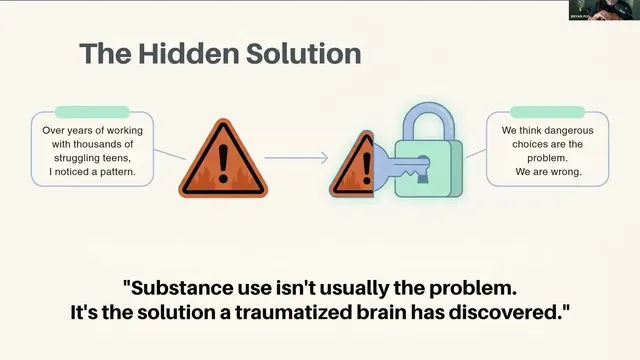
18:40So why do kids hurt themselves? Well, cutting is a survival skill. I don't know if you've heard that before because a lot of times we think that cutting is sometimes you're led to believe that because your child's cutting, that that means they wanna harm themselves. But that means they want to actually commit suicide. It does not. Cutting is a way that a child releases emotional pain and energy that they cannot express otherwise. And we're gonna dig into that a little bit deeper. But when a child cuts, it is a literal release. It turns on chemicals in the brain that help for a moment gives them, it's like letting steam off. So when a child is cutting, they're not trying to commit suicide. That's so important, but that's so scary
19:35because a lot of times the child cutting will get the parent to call the police or get the parents to call 911. And unfortunately, what happens is the cycle of emotional pain and suppression just continues and it's prolonged. So then what happens is children start cutting more and more and more. Here's the thing, cutting is like an addiction. It is an external attempt to soothe an internal state. Cutting does not mean your child wants to kill themselves. Cutting does not mean that they want to in their life or that they want to make your life worse. It is, it becomes an addiction. It is an external attempt to soothe an internal state.
20:25Now we have two ways to react. Now there's the old paradigm way, which is a lot of times what we do. And then there's a new paradigm way, which is a way that I teach parents and professionals outside of the matrix. So when you move outside of the matrix, you can have this love response. Now I'm a pioneer in love-based parenting methods. So I've been doing this for a long time. But how do we normally react when it comes to a depressed child or a child who's cutting or a child who's even threatening to harm themselves? We panic, we lecture, we threaten, we punish or we demand answers. Here's what we want to begin doing. We want to be able to regulate ourselves first. Talk about that. We want to listen, we want to protect, and we want to offer presence.
21:20Now I've had so many experiences. I've had so many experiences with these dynamics. And what you've got to understand is that fear makes us panic. Love helps us stay calm. And one of the most effective ways, the single most effective way to remain calm is to breathe, is to practice your breathing. You have got to practice your breathing because when your child's stress goes up and their emotion goes down, then your stress is gonna go up too. Your emotion is gonna go down. And when your emotion starts going down and you start regressing, you're gonna start feeling really helpless. And so that's why our fear, and see, I actually need to change this.
22:15Because this says, and this is the way my brain works, and I'm just, I'm actually just really, as I start looking at these slides with you all tonight, I'll start analyzing them. So it says we have two ways to react. What's important about that word react? React is unconscious and it is without thinking. A reaction is emotional. That's important. See, a reaction is emotional. A response requires conscious thought. A response requires conscious thought. So it should be the fear reaction and the love response. The fear reaction and the love response. Because when you panic, that's automatic. That's unconscious. You don't even realize that you're panicking. When you start lecturing, why are you lecturing?
23:10Have you ever asked yourself, why are you lecturing? It is because your emotions kick in, and when your emotions kick in, they start driving your logical brain, your thinking brain. It's like a hamster wheel. When you become stressed and your emotions kick in, your thinking brain starts speeding up and then you start lecturing, because that is, believe it or not, it is an attempt to try to control. So when you're lecturing, you're actually trying to control. When you're threatening punishment, or even when you're punishing, you're trying to control and I call this, you know you're stressed when you control, suppress and change behaviors, or demanding answers. You're trying to create safety for yourself. When you're having a fear-based reaction, this has nothing to do with your child and everything to do with you. That's why we have to be able to move over to a love response.
24:05In the love response, the first thing you have to do is you have to be able to regulate yourself. And how do you start regulating yourself as you gotta breathe? But here's a question I wanna ask you. Before your child, have you ever had any experience with suicide, depression or cutting? Before your child came along, did you ever have any experience with suicide? Any experience with depression? Any experience with cutting? Because if you did, what happens is now you have this child who's demonstrating and expressing those behaviors, which is actually an energy, that energy is going down in your brainstem, looking for an old experience, an old matching experience, an old matching vibration, and that's what's driving that panic and that fear reaction. So that is really important, really important.
24:57You are the medicine. Calm is contagious, so is panic. So if you have a child who is threatening to cut and you start to freak out, then it is going to increase the likelihood of them cutting. And I'll give you an example. And I'm sharing this information. This is coming from years of experience. So I want to give you insights. I want to give you some gentle guidance, but you have to understand, I've been doing this for 30 years. This is something that I am used to doing. You have to, if you're receiving professional support, I want to encourage you to talk to your therapist or your coach or whoever it may be about what you're learning and what you're thinking,
25:52see what they have to say, but I really want you to be mindful because this can be a really, a really tenuous process. But I've been doing this a long time. I'll tell you a time, I had a, it was about a 12 year old. It's funny, I got a lot of 12 year old clients in my world right now. It's so interesting. But he was about 12, he may have been, actually he was 13 because I had a group home with adolescent boys ages 13 to 18. And he got really upset one night. Bam, he tosses this coffee cup. I'm going to stop the share for a minute. Sometimes I'll start talking and it's just, I just prefer to be on the screen for you. So we're in the group home. He gets mad because he said the other boys were picking on him and he was drinking some hot chocolate and he just, wham! He slams that hot chocolate, that mug against the wall
26:48and it just splashes everywhere and the little shards of glass go everywhere and I'm standing in the kitchen and I didn't move. So when I talk about not reacting and not panicking, the very first action is to stop and to breathe. It is the very first action. If you immediately move into momentum, 99% of the time that momentum is going to be being driven by stress, your stress. And if you're doing that, then you're sending a vibration. That vibration, which is a stress vibration is going to match your child's stress vibration, which is going to create more stress. So I didn't move. I took a deep breath and he was sitting at the end of the kitchen table.
27:43And then I still hadn't said anything. All the other boys were like, oh man, just see what he did. Oh, he just made a big mess. I said, guys, I got this. You guys need to go on, leave him alone, leave us alone, leave us alone. Shoot him off, just shoot him off. And he picked up this little shard of a coffee cup and he starts cutting into his forearm. And at this point, I had not moved. And all as I said is, I can see you're upset, buddy. And he's got the little shard, he's scratching his little arm. Now, why have I not moved? Because a regulated brain a brain that is not in survival is able to more accurately assess
28:38what is actually happening. He's scratching his forearm. He's not cutting a vein. He's not gonna kill himself. He's not slashing his throat. He's not going to die. But only a regulated brain can determine that. And only a brain that I am feeding with oxygen and consciousness and oxytocin can see that because in times of stress, our thinking becomes confused and distorted and our short-term memory suppressed. So when you're faced with a stressful experience, you have to stop and breathe. And so then he says, they keep picking on me. And I walk over real slow as he's cutting himself and I gently put my hand on top of his
29:33and I said, let's not do that. Let's not do that. And it's all I did. I just took his hand with the little shard and I just set it down. That's all I did. Just as gentle as can be, let's not do that, bud. And I set it down and within moments he got up and he started rinsing his arm off. And then I started picking up the shards. I interrupted that cutting by simply slowing down, getting really present, being attuned to the environment, honoring what was going on with him. And he's sat there and he's said a little, he told me how upset he was and how sad he was. And within, and this is important,
30:29in probably less than 20 minutes, he had gone over, balled up on the couch and he fell asleep. What does that tell you? That tells you how stressed out he was because a stressed out brain goes into hypoarousal, goes from hyperarousal to hypoarousal. There was something in that dynamic that was completely overwhelming for him. And it was just that one incident. And I don't remember if he cut again or not or the thing is, but he was looking for a charge. When he was cutting, he was looking for a charge. I don't wanna get to talking too much. I'll get to talking too much and then we'll run out of time because I have a tendency to do that. Okay. So calm is contagious, so is panic. If you get loud, they get louder. If you soften, they soften the goal, share your calm with them.
31:25What does that mean? Share your calm with them. This is important. Hi. Hi. I don't know who's high in me. I can't see your face, but you sound. You got a sweet little voice. It's me. Who is it? It's me. Hey, buddy. Hey, good to hear you. I miss you. I miss you too. I miss you too. Thanks for joining me tonight. Mm-hmm. All right. All right, I'm gonna get back to teaching. So what does sharing your calm mean? This is really important. When you are breathing and you are regulating, you are producing a hormone in your brain called oxytocin. When you are stressed and when you are scared and when you are overwhelmed,
32:21you are producing a hormone called cortisol. Cortisol is your brain's primary stress hormone. So if I'm stressed out and if I'm cutting or if I'm hurting myself or I'm threatening or if I'm really mad, then I am producing cortisol. Now, here's the significance between cortisol and oxytocin. Cortisol is automatic. Oxytocin is a learned hormone in your brain. So cortisol is online when you're born. When you're born, your amygdala is already developed and it's already surging cortisol because another part of cortisol is that it is responsible for helping you to live. It helps you grow, it's like fuel, but too much cortisol damages the brain. Too much cortisol damages the body, damages the entire body-mind system. Now, oxytocin, that structure, which is your hypothalamus, that doesn't come online until you're three years old.
33:18So you have to, oxytocin's not automatic. You have to learn how to release oxytocin and how do you learn to release oxytocin? See, oxytocin is your brain's anti-stress hormone. So when you're early in your development and you're stressed and you're surging cortisol, if you don't have a loving, nurturing, attentive caregiver come and soothe you by turning on oxy, the soothing is the oxytocin, then you don't develop a healthy oxytocin response. So if you go all the way back in utero, and if in utero, you were really stressed and you were really overwhelmed because your biological mother, whoever, the person carrying you in utero was stressed and overwhelmed whatever they were experiencing, you were experiencing, then, and if they didn't soothe themselves, then I have this fantastic video I used to share. I show this mom who's pregnant.
34:13She's a prostitute and she's pregnant and she's also a crackhead and she'd been up, she'd been up like 24 hours, but been up like two or three days, I think. But at one point she was like, I hadn't slept. I wanna share that with you all. I'm gonna share it with you right now. Hang on just a moment. I gotta stop my share. I, and the reason I love this video so much is because I used to show it in all my lectures and it was produced by a guy named Michael Mierendorf and it is a HBO special. And for whatever reason, it was out of publication. And so I actually just recently found Michael, I looked him up and I'm like, hey dude, I used to, let me tell you how long I've been doing this work. I used to have this video. I used to have this video on a VHS tape.
35:09And I said, Michael, I sent me an email. I said, you know, it's Bryan Post. I showed the Broken Child video for 20 years. And I said, I can't find it. And he said, what's your address? And he sent me a flash drive with it. And so I downloaded it to YouTube and I made it unlisted. So this is unlisted. You can't just go and find this on YouTube, this is a fantastic video. This is called the Broken Child. So I just put it in the chat. If you can take a screenshot of the chat of this or copy it, because this is a fantastic video. There's so much good stuff in this video. And I show this, there's a clip. And I used to show this to my lecture.
36:05I'm gonna start showing it again. I've been sharing this with all my coaches who've gone through my certification process because it's so educational. But there's this fantastic clip of this woman who's pregnant. And if you can just imagine that if you are a fetus and you have a drug addicted mom who's not sleeping, you're being constantly exposed to cortisol. And that cortisol strengthens in your brain, your amygdala over develops. And so then you are born and then you're growing up. And then all of a sudden you, if you don't have, if you have, you know, let's say you get put into foster care or let's say you get adopted and let's say you have disrupted placements and let's say the adopted placements disrupt the foster, you have frequent foster placements. I've worked with kids who've been in 70 different foster homes.
37:01It's like crazy. So that's just constant stress. So the amygdala's constantly pumping out cortisol and it hasn't learned how to release oxytocin. So when we go back to the concept of when stress goes up, your emotion goes down, your logic goes down, then what is also going down when stress goes up is your oxytocin. So your ability to calm yourself is significantly diminished. And so when I say calm, calm is contagious. Then what I am telling you is that when you are breathing and when you are calm, your brain is generating oxytocin. And that oxytocin signals to your child's brain, which then turns on oxytocin for them. Now, let me tell you something. If they went, if they went extended periods of time in a lot of cortisol early in their life,
37:56remember stress goes up, emotion goes down. So when stress goes up, you're emotionally regressing. So in times of heightened stress, they're regressed. They're not 15, they're five, they could be two, they could be an infant. That's a physiologic reality. I'm not just making this up. When we become, Allan Schore wrote a book called Affect Regulation and the Origin of the Self. He wrote three of them and they're about this big. I got one of them right here. And they're all like this size. I'm gonna stop the share for a moment. This is, people don't realize this is my library behind me in my office, but they're all this thick. So this is Affect Regulation and the Repair of the Self. But he wrote Affect Regulation and the Origin of the Self, which was the very first one. And in that book, he quotes stress research and he says, in times of stress,
38:54some adults have the ability to revert, regress to infancy, to infancy. So that whole act your age, not your shoe size, that is a biological reality. So if you regress and you regress back to a time when you were not in an oxytocin-rich environment, then you are relying on your own self-soothing ability. And if you were not in an oxytocin-rich environment, you're reverting back to an environment of stress. So that's where we go back to addiction, which is where we go back to cutting because cutting becomes an addictive behavior, an external attempt to soothe an internal state. So when I say calm is contagious, what I am telling you is neurologically, vibrationally, energetically, when you are calm,
39:50you are sending a signal to the more stressed out brain. Daniel Goleman, who wrote a book called Emotional Intelligence 25 years ago, said the calmer brain has the ability to soothe the more stressed out brain. Well, this is before he was talking about oxytocin. This is before we knew about oxytocin. He was talking about the amygdala. He said the calmer amygdala has the ability to soothe the more stressed out one, but it's not the amygdala at all. It's the hypothalamus, so you're turning on oxytocin. So calm is essential. It's essential, it's so important.
40:29Okay, so the path to healing. Number one, let it out is the emotional expression. I'm gonna, I got another slide that's gonna follow this one. Number two is name it, number three are new skills. So number one is gonna be really challenging. So I'm gonna get into that. So I created this framework called the three pathways of emotional expression. Attitudes, feelings, and behaviors. Now here's the thing. So I've got, as you can see, I have green, I have yellow, I have red. What does that remind you of? Like a stoplight, right? Green, yellow, red, except the red is on the top or does it matter? I see, I had to think about that. Okay, green, yellow, red. So greens go, yellow is caution, red is stop. Oh, this is gonna be good. This is about to get really good. Here's the thing. We all have these three pathways of emotional expression. Again, remember, we're outside of the matrix.
41:25We're outside of the matrix. I don't have a brain that thinks like society does when it comes to parenting. My brain thinks differently. So I'm outside of the matrix. So the way we grew up, attitudes were not okay. So these are all emotional pathways of expression. And what is emotion? Emotion is energy in motion. That's a whole other webinar. Emotion is energy in motion. That is the definition of an emotion. Energy in motion, meaning your cellular system vibrates, creates an energy. That energy becomes an emotion. The energy is moving. So we have three pathways through which we express emotion. The first is attitudes. All of you grew up, you could not have an attitude with your parents. Very few of us could get away with an attitude
42:20because it was defined as a sign of disrespect. So you couldn't have an attitude. So if you can't express through your attitude, you drop down to your feelings. Very few of you, very few of us could express our energy through our feelings because it was a sign of disrespect. Don't talk back to me. Don't you raise your voice. You lower your voice when you're in my house. You know, the story I don't have to tell you, you're all familiar with it. If you can't express through your attitudes and you can't express your feelings, guess what, you drop down to behaviors. You drop down to behaviors. That's why it's green light, yellow light, red light. Because what happens at behaviors? How many of us grew up being able to have behaviors and just get away with it? We could not. Most of us, I got whipped. If I had behaviors, I got whipped. And so what is that? It is a form of emotional suppression. That's why I say when you're stressed, you try to control, you try to suppress or you try to change the behavior.
43:17When you're stressed, you try to control, you try to suppress or you try to change. C-S-C, control, suppress, change, behavior. But look at the top. It's the emotion that's getting pushed down and down and down and down. So if you can't express your attitudes and you can't express your feelings, you drop down to your behaviors, then guess what you have? Anger and depression. Anger and depression. Guess where anger and depression have to go? Anger and depression have to go through behaviors. I call this the trauma triangle. Because if you can't express your attitudes and you can't express your feelings and you get suppressed down to behaviors, and that means your anger and depression energy has to come out through behaviors, which means you're gonna continue to get suppressed. If you're in this state, if you're living in anger, depression, and behaviors for six months or longer, you're living in a state of trauma.
44:12And some of you have been in therapy for five years. Which tells me you've been living in a state of trauma for five years. That's why some adopted parents get ready to give up because you are freaking tired. You are exhausted. You've been living on a battlefield for the last five years, not even taking into account what battlefield you came from. I came from a battlefield. I came from a battlefield. I came from me personally. I came from in utero being placed for adoption. The trauma of a mother who knew she couldn't keep me. I came from that. I came from the battlefield of foster care. I came from the battlefield of being raised by a father who had severe post-traumatic stress disorder and a mom and a dad who were adult children of alcoholics. I came from that battlefield. So we all as adults, as parents,
45:07we come from our own battlefield in addition to the battlefield you've been on with your child in a society that says children cannot express their attitudes, they cannot express their feelings and they cannot have behaviors. And then what happens? Anger, depression and behaviors have to be expressed. Here's how you know you're living in the trauma triangle. You get these behaviors and many more. A child who is cutting is a child who is stuck in behaviors. A child who is diagnosed is a child who's stuck in behaviors. But child who's on medication is a child who's stuck in behaviors. Residential, destructive placement, restraint, suicide attempts, running away, drug use. And so many more. So many more. You know that you are stuck in the trauma triangle. And here's the thing.
46:02Here's the thing and I love this, I love my slide so I'm gonna stick with this. And I have another one. This is important. So we'll go through those real quick. And I'm not gonna keep you guys on here forever. Yeah. I'm doing that thing where I talk a lot. I wanna make time. I'm gonna make time to answer questions as well. So I'm gonna stay on and I'm gonna answer questions for you. But here's the thing. Now if we back up, listen to me. Listen to me. We're outside of the matrix here. You don't get this everywhere. You don't get this information everywhere. So listen to me. What is an attitude? An attitude is an emotional expression. It is energy in motion. An attitude is not disrespect.
47:01An attitude is a green light. Ignore the attitude. Ignore the attitude. You don't have to tell your child don't roll your eyes at me. You don't have to tell your child. Don't you talk to me that way. You don't have to tell your child. When I was your age, I never would have talked to my parents that way. When your child gives you an attitude, ignore it. And it will be so hard. It will be so hard. Because you have all these parental blueprints from your great grandparents to your grandparents to your parents telling you that that attitude is not okay. I operate from outside of the matrix so I can tell you to ignore it. Because I know that if you can ignore it, this will reduce 50% of the problems and the conflict you have in your home. Now, what happens if your child drops down to feelings? That's the yellow light. Here's what you do with feelings.
47:56You encourage them. You want them. You desire them. You need them. The feeling is the path to the healing. I'm gonna tell you that again. I'm gonna tell you that again. You're only gonna hear that outside of the matrix because inside of the matrix, everyone wants to suppress the feelings. Inside of the matrix, feelings hurt people's feelings. Inside of the matrix, it's the way someone expresses to you. The feelings they express hurts your feelings, makes you upset. Outside of the matrix, feelings are nothing more than an energetic expression. That's it. Because I know that the feelings are the path to the healing. You want the feelings, encourage the feelings, need the feelings, desire the feelings, beg for the feelings.
48:53Listen to this. This is gonna be so challenging. This is gonna be so challenging. If your child is in attitudes and if your child is in feelings, if you can keep them into attitudes and feelings, you want those feelings. Guess where they never go? Behaviors. They never go to behaviors. If they never go to behaviors, then the anger and depression doesn't drive the behavior because the anger and the feelings and the depression feelings, the energy, that energy that manifests itself in anger, that energy that manifests itself in depression, that energy that's manifesting itself in the behavior never occurs. But what happens is our children get conditioned for anger, depression, and behaviors because in our society what we wanna do
49:49is we wanna diagnose, we wanna medicate, we wanna send away, we wanna threaten, we wanna punish. So then what happens is we never give them another outlet. So they become conditioned. They become conditioned. Their brains are conditioned for anger, depression, and behaviors because we're not giving them another outlet. Here's the other outlet. The other outlet is to allow them to have their attitudes and to want their feelings. Want their feelings. So if a child is in behaviors, if they're in behaviors because that's conditioned, when they start to have those behaviors, you have got to want their feelings. They're gonna give you all of those in the midst of those behaviors, what you want are the feelings. Honey, I need to know how you feel. I need to know how you feel. I need to know what's going on. I want it. I wanna listen, I wanna hear you. And then you gotta listen when they start yelling
50:44and when they start cussing and when they start screaming at you. You can't say stop screaming at me because the feeling is the path to the healing. The feeling is the path to the healing. I'm telling you, it's energetic. The feeling is the path to the healing. You have to want the feeling. You want a child to stop cutting. You want a child to not be suicidal. You want a child to be able to move out of their depression. Then what their freaking feelings need the feelings. And I could get a whole lot more passionate than that. And I'm telling you, I'm kind of dialed down this evening. I mean, I could turn it up even a few more notches, but I think everyone on here is feeling me. I get the sense that you're feeling me.
51:36So step one is let it out. Permission before correction. Stay close. Lower your voice. Use fewer words. Why are you using fewer words because your child is already stressed? If you keep talking to them, you're stressing them out even more. So you use fewer words and you let the tears and the anger come. Oh my gosh. Try to connect to the tears and the anger that you have. Try to see the baby within the child. Stop seeing the mad 15 year old or 12 year old or 18 year old. See the baby within the child. Connect to the baby within the child who in that place feels all alone. Feels like they can't be heard. Feels like no one cares. Feels like no one loves them. Feels like they got a survival on their own. I'm not here to fix you. I'm here to be with you.
52:32Bruce Perry says the brain, listen to this. The brain always returns to the way the event was handled the last time. Repetition and emotional impact is how you change the brain. Sometimes your child's gonna be stuck in behaviors and it's gonna be so hard because they didn't get there overnight. They got conditioned. They got conditioned into behaviors I think Jose and Jasmine may have felt falling asleep. I'm having to admit some people maybe they're getting engrossed in the presentation. They didn't get to behaviors overnight. This is a brain based state. Cutting is a brain based state. Depression is a brain based state. Threatening suicide is a brain based state. These are states of helplessness. These are states of overwhelm. These are states of not being good enough.
53:29These are states of no one cares. No one's gonna come for me. No one wants, no one can handle my feelings. I'm not here to fix you. I'm here to be with you. So when I said to that child, and listen, I said to kids, I've said to me cutting is nothing more than a cry for help. It is a child saying, I don't know how to get these feelings out. And I have said to a child before you cut, I can't stop you from cutting. This is what all of you need to understand. You can't stop your child from cutting. You can't stop your child from committing suicide. You can send them to the hospital. You can have the cops come. You can have them put in a straight jacket. You can have them medicated. You can send them to umpteenth amounts of therapy. But at the end of the day, if your child or anyone else wants to kill themselves,
54:24that's what they're gonna do. You can't stop it. And it is a fear-based figment of our imagination that thinks that we can. But what you can do is you can be present. You can be compassionate. You can be understanding. You can be engaged. You can be passionate and compassionate. You can want the feelings. You can stay close. You can let that child know how devastated you'll be if they ever hurt themselves. See, that's all emotional. That's all authentic. See, that's not trying to control. That is trying to be in relationship. That is expressing understanding. This is important. Remember, I told you it's scary stuff. I operate outside of the matrix. So you name it. What is the feeling protecting them from? Every behavior is trying to solve a problem.
55:20Is it protecting them from rejection, failure, shame, the magic question? What feels the scariest right now? Have you ever asked your child that? What feels the scariest right now? Or what are you afraid of? Or what am I missing? What am I not hearing? Your child says, I'm gonna kill myself. Of course you wanna know if they have a plan. That's important. You wanna know if they have a plan. If they have a plan, that's different. You gotta take action. You gotta take action. Here's the thing, if your child says they have a plan to kill themselves and you have got to call 911 because that is at the peak. It's always, do you have a plan? Do you have a plan? And this is important. Don't be afraid to ask. Don't be afraid to ask, do you have a plan? Every professional is trained for that. If someone says they're suicidal, you ask,
56:15do you have a plan? Because when you have a plan, it's more concrete. Do you have a plan? If they have a plan and you don't know what else to do, then you call 911. But if they don't have a plan, then you've got to calm yourself down. You've got to stop panicking and you gotta get connected. You gotta get to the roots. You gotta want the pain that's driving the overwhelm. You gotta be able to connect and listen and understand and be a source of support. But you can't get fearful and you can't let that overwhelm you. Even if you've got to call 911, you don't want to be in a place of panic. If you're panicking, you might not even be able to dial the numbers fast enough. Panic is not going to help you. Being fearful and overwhelmed is not going to help you in any of the situations. The magic question, what feels the scariest right now?
57:10And then the new skills. Replace the behavior, don't just take it away. But think about that for a moment and here's the thing. And I'm not giving you therapeutic advice right now in this moment. I'm just providing education. I have said to a child, if you decide to cut because I know I cannot keep them from it, will you come to me first and give me an opportunity to soothe you? Give me an opportunity to listen to you. Give me an opportunity to understand what's going on. Before you cut, and if I cannot support you, I will be right there with you. I will make sure that you have alcohol and bandages to clean yourself up so your cuts don't get infected.
58:07I've done it before. And what am I doing in the process? I am becoming, when I'm not panicking, I am becoming an effective co-regulator. Because see what the child is doing is they're trying to regulate themselves and they can't do it. So I want to become an effective co-regulator. But the only way I can become an effective co-regulator is if I can keep myself regulated. Because remember at any time you can call 911. At any time you can do that. But can you be regulated and stay connected and stay present without getting overwhelmed and scared? Because that just generates more stressful energy. Again, I'm talking to you outside of the matrix. I'm talking to you outside of the matrix. This is not common practice. There are probably some of you right now freaking out. Cold water, a drink of cold water can ground the physiology.
59:06You can ask your child, can you just take a drink, honey? Just take a drink. But the whole key is to stop panicking, stop freaking out, go for a walk. Can we go for a walk together? Can I just sit here with you for a little bit? Presence, oxytocin, pressure, a weighted blanket. Oh, I love weighted blankets. Music, the goal is to give the nervous system. Give the nervous system a way to start feeling better. It's about regulating the nervous system. When thoughts get dark, are you thinking about hurting yourself? Asking does not put the idea in their head. It shows them they aren't alone. So good. Stay calm, ask directly. Honey, are you thinking about hurting yourself?
1:00:02Yes. Okay, thank you for telling me. Thank you for telling me, then you get quiet. What can I do? What's going on? How can I support you? Oh, scary stuff. Scary stuff. Safety first, love protects. If there's a plan or intent, treat it as urgent. It is urgent. If there is a plan and this is for suicidal threats. Now, let me tell you something. A child who says, I'm gonna kill myself, I'm gonna kill myself in a moment of emotional uproar usually is just a suicidal threat. It's not suicidal ideation. It is just a threat. It is an emotional expression. It is a feeling expression.
1:00:58You can just as equally match that with, that would make me really sad. It'd make me really sad if you weren't in the world, but you have to pay attention. You have to be cognizant. Remember, safety first. If you have to call 911, that's what you gotta do. Because this, what I'm teaching you tonight, when that child comes back from the hospital, you're right back to square one. And this is where you wanna be. This is where you wanna be. This is the stuff you wanna be working on. Because this is the stuff that leads to real healing. And when you're stuck in behaviors, sometimes you gotta go through that healing process. Healing is a journey. It is not an outcome. It's a process. Lock away medications and sharps. Of course, if you can do that, that's fantastic. But a paperclip, I got freaking paperclips. A paperclip for cutting anything. Let me tell you, just can't prevent it.
1:01:54But you can make yourself available. You can't prevent it, but you can make yourself available without shame, without guilt. You can say, honey sweetheart, if you're thinking about hurting yourself, just come let me know. Come let me know. Make yourself available, get present. That is the greatest sense of safety. And then of course increase supervision. But it's not even supervision. It's attunement. It's paying attention. This isn't about not trusting. This is really important. It's not about not trusting. It's about keeping them safe while they heal. See, that's important. It's not about not trusting. It's about keeping them safe while they heal.
1:02:39Okay, what to say when you don't know what to say? All right, so as I said, I appreciate you sticking with me. See almost everyone's been here the whole time. Thank you so much. I'm about to give you a little free gift. It's gonna help. It's gonna help. All right. So what to say when you don't know what to say? I'm not scared of your feelings. In the past you've probably, when you say don't talk to me that way, you're saying I'm afraid of your feelings. When you say, lower your voice, when you say don't yell at me, you're saying I'm afraid of your feelings. The only reason, the only reason when your child is expressing their feelings, that you tell them don't do that is because you're stressed. You have to breathe. You have to calm yourself down. You have to realize you're not gonna die. And then you have to say, tell me more.
1:03:37I had a little interaction with a little friend of mine last night, 12 years old. He was so upset. So upset. We were in a parking lot for like an hour behind the department store. We walked all around that place. He was so upset. He was yelling. He was cussing. He was so mad. He was so sad. And I said, buddy, you're so sad. And I said, and you're so angry. And I said, tell me more. And he just started telling me more. I mean, just let me have it. I do, I really do this stuff. I don't just lecture about this stuff. I don't just teach this stuff. I do this stuff. And he ran at me some more. And I'd say, tell me more. And I'd say, what else, buddy? And then I'd say, I'm sorry, man. I'm sorry. And I said, what else? Tell me more. And I knew when he was telling me, guess what? Oh, this is what we don't realize
1:04:37when your children start talking to you, whether they're yelling at you or whether they're cursing you, they're not dropping into behaviors. How is that so difficult? If you can get your child to talk to you, if you can get your child to yell, if you can get them to curse, if you get them to scream, if you get them to cry, if you can encourage that, they're not gonna drop into behaviors because the energy is being discharged. It's the pent-up suppressed energy that drives the overwhelm, drives them into their brainstem where their rejection is at, where their abandonment is at, where their shame is at, where their overwhelm is at, which causes them to do things like hurt themselves and try to kill themselves. And I say words like that
1:05:32because I am so comfortable in this work. I can say to a child, I don't want you to kill yourself. That would make me so sad because I am comfortable because making the statement is not plant the seed. The seed has been there. And for many of you who have adopted children, the seed came from in utero. Many of you who have adopted children and foster children, they're in utero, their parents thought about killing them, thought about aborting them, or they lived in domestic violence where they didn't know that they were gonna live. So the seed, the seed of overwhelm and suicidality lives within them. My biological mother was supposed to have aborted me. So the seed, the thought is energetic. So the thought is energetic, which then speaks to the baby.
1:06:27The infant feels the energy of the thought, the thought, much less the words, much less the actions. So when I'm really stressing, I'm in my brainstem, the energy is already there. You saying the words doesn't plant the seed, the seed has been planted. That's why you're looking at what you're looking at. You don't have to carry this alone. I love you more than I am afraid. I love you more than I am afraid. That is so good. Okay, here's your free gift. Bondify.ai. I want all of you to be on Bondify because guess what? When you don't know what to say, you can go on Bondify and you can ask me. I developed Bondify for parents
1:07:23in the moment of stress and crisis when they don't know what to do and they don't have anywhere to turn and it could be 11 o'clock at night and your counselor to sleep, your social worker is not available, I created Bondify. Go to your Apple store, go to your Google market and you can download Bondify for free. There is no charge. It is full of educational information. We have a whole community there. I'm about to start giving weekly Q and As. We do have a premium version but you don't have to have that access to that to use Bondify. I want everyone to download Bondify. It's my gift to you. This took me three years to develop. It is fully programmed. It is like talking to Bryan Post on your phone. You just text it. You can ask me any question and if you'll program it because it has an onboarding feature.
1:08:18If you will give it the information, this is Bryan Post AI. If you'll give it the information, the struggles that you've been going through with your child, it will learn to respond better and better and better. It is equipped with 30 years of my knowledge. Sometimes I use Bondify to respond to questions because the questions are more thorough than the questions that I can give right off the top of my brain or I just won't have time. But I have parents reaching out to me all the time, emailing me, texting me. And a lot of times I'll just send them a message that I copy from Bondify. So all of you, I want you to have this. This is my gift to you. You can go to your Apple store. You can go to your Google market and you can start using this thing tonight. And I know some of you are already using it. So that's fantastic. But there's no parent that should go into any crisis and doesn't know where, doesn't have someone to turn to. And this is Bondify is your turn to.
1:09:17Okay, so what helps versus what hurts? What hurts, shame. If it creates more stress and creates more fear, it's going to create hurt. If it creates more love, if it creates more understanding, if it creates more compassion, if it creates more empathy, it's going to help. So presence, just being there, you don't have to always be talking. Stop talking so much. Get quiet. Cause when your child is stressed out, their sensory pathways are all activated and overwhelmed. So stop talking. But again, I'm telling you, this is all outside of the matrix stuff. This is not the ordinary stuff. You don't get this from the community that you're in. You don't turn to other parents. You don't have this community of support to hear this information to feel like this is okay. I wanna be able to provide an opportunity for you to have this kind of community for you to join us outside of the matrix
1:10:12where parents are having impact and actually feeling empowered and not disempowered and not victimized all the time where they're actually going through these processes with their kids. Where they've gone through processes of their kids being hospitalized and them calling 911 and the kids come home and they still start at square one. What are they gonna do next? You gotta do something different outside of the matrix. That's what I wanna be able to do for you. Isolation, what hurts is leaving them alone. Now listen, listen to this. Leaving you alone means I'm gonna stop talking to you. I might come out of your room but I'm gonna be right outside your room. Or I'm gonna go fix you a snack and I'm gonna bring it back and I'm gonna knock on the door and I'm gonna say, hey, I left something out here for you, a little snack for you. And I'm gonna leave it there. And I might sit out there and I might just come back in 10 minutes. And hey, I love you.
1:11:08Can I come in? You might get a yes, you might get a no. Don't be surprised if you get a yes. If you get a yes, you go in, find a place to sit down, don't stand up, find a place to sit down, breathe and listen. Listen, get quiet, don't interrogate. Get present. When you're stressed, you cannot be present. When you're stressed, you can't be present.
1:11:42Okay, let me talk to you about something. I'm gonna talk to you about, our sponsor for tonight is LEAF Wraparound and Love Pathways. Both of these I'm clinical director of. These are nonprofits in Northern California and Central California. So this is for adoptive families. If you're an adoptive family and you are in crisis, if you're in high risk, if your child is at risk of being sent away from residential or maybe they're in residential and they're gonna come back or maybe you're considering terminating your adoption. These are the levels of families that we serve in our Wraparound program. And I would be remiss to not share this with you because I know that you're gonna continue to fail and I know that I have a whole team of people who are available to be able to support you, including myself. So I have two programs, LEAF Wraparound, Love Pathways, both of them,
1:12:39familiar, certified in this methodology, my Fear to Love methodology. But here's how you qualify. Northern California is all of Northern California, from Sacramento up. Sacramento to Napa to Santa Rosa up. Central California, we serve San Jose, we serve Stockton, Modesto, we serve Fresno, we serve all of Central. And now we're moving a little bit over to Alameda as well. So either one of these, if you qualify, if you're an adoptive family, and if you're at risk, I want to encourage you to reach out. You have to be adopted. So there's a program called Wraparound Services through adoption assistance. You have to be adopted from a county in California. You gotta be at risk of a placement disruption, not to be previous therapeutic support. You must be receiving adoption assistance. And you have to be under 18 unless your AAP has already been extended to 18, to 21.
1:13:35Now, if this is you, you can talk to us right now. I have an AI system that you can engage with right now. I don't want you to wait. If you need support, if you have a child who's challenged with the issues that I've been talking to you about this evening, I want you to reach out. You can either use LEAF Wraparound if you're in Northern or you can go to Love Pathways. Either one, and we can actually engage with you this evening. So we can ask you questions and we can get you started this evening and then you will talk to someone tomorrow. You do not have to continue to suffer and to struggle because here's the thing, we're all gonna suffer and we're all gonna struggle. It's whether or not you're gonna get support in the process. So I'm clinically involved with both these programs and I train and I teach and I support
1:14:34many of the families in these programs. We have a whole team available to support you. Now here's the thing, I'm gonna show you this video. I developed this, I had my animator, Irina create this because here's the truth. In life, we're all trying to climb Mount Everest, the Himalayas, but some of us are gonna make the climb and others of us are not. But in life, especially when it comes to parenting and when it comes to trauma, you pretty much have three options. You either suffer and don't do anything different. You just continue to struggle. You're after year doing the same parenting matrix stuff or you try to make the climb all by yourself
1:15:30or you make the climb with support. And I want you to make the climb with support. Let's watch this real quick.
1:16:30And here's the thing, I've climbed that mountain a thousand times, I am an emotional Sherpa. I am training my team to be emotional Sherpas. We are all going to suffer. We're either gonna suffer the pain of doing nothing and we're gonna suffer that. We're gonna suffer the pain of trying to do it on our own or we're gonna suffer the pain and have someone walk beside us who's already gone up that mountain a thousand times who knows the pitfalls and the valleys and knows when there's gonna be an avalanche and knows how to get to base camp without dying. We're still gonna suffer, but we're going to walk together and I've already been up that mountain a thousand times and that's what I want to be able to do. That's what Bondify is. Bondify is me supporting you and that there's no charge to Bondify. That's what wraparound services are. If you qualify, that's what wraparound is.
1:17:25There's no charge, there's no charge. You can access that in the state of California. You're able to do that. This webinar, free of charge, no charge. I want to walk with you because I know it's challenging because here's the thing, every day counts. If you're on this webinar tonight, if you're on this webinar tonight, you don't have time to keep screwing around because your child's brain is changing. Every day your brain is changing. Every day, your brain's changing, your child's brain is changing. Every day counts. We don't have time to keep doing the same thing and expecting a different result. That is insanity. I want to be able to support you. Download Bondify. Don't get off of this webinar tonight and decide to not do anything different.
1:18:21Even if it's challenging, even if what I'm telling you is challenging, that's what it's supposed to be. It's supposed to be. It's not supposed to be easy. The suffering to get to this point was not easy. It's not going to be easy to get to the healing. Don't let another day go past without getting the support that you need. Every day counts. Every day counts. And we're operating outside of the matrix and you're not going to get the support in this education inside of the matrix. You've already done it. You've already done it. You're not losing your child. You're seeing their pain. When pain comes to the surface, healing can begin. Remember, the feeling is the path to the healing. The feeling is the path to the healing. Fear says, fix it. Love says, stay.
1:19:19All right, that's it.
1:19:21I am now going to open us up for questions. Do we have any questions? Actually, yes, Bryan, that's the question here. How to resolve lying? How to motivate my adopted son to do non-preferable tasks? Non-preferable? Is that what they used? Yeah, non-preferable tasks. How many of us like to do non-preferable tasks? You didn't show hands? I don't like to do non-preferable tasks. We all like to do tasks that are preferred. Jasmine, do we have How to End Lying as a link? Let me double-check real quick. I know I have it as a PDF. Yeah, I know we have a PDF. I don't know if we can post a PDF in the chat. I have a book called How to End Lying.
1:20:18Here's the thing. Lying is an external attempt to soothe an internal state. I'll give you a really simple formula. The first thing you gotta do with lying is you gotta stop getting stressed out over it. When your child tells you a lie, it is a survival mechanism. When they lie, they are stressed. So when they lie, the worst thing that ever happened to them is threatening to happen again. Now, here's the thing. When they lie, you get stressed and then you want them to tell the truth. Well, they're not gonna tell the truth because they're stressed and the worst thing that ever happened to them is threatening to happen again. Here's the formula. Ignore the child. Ignore the lie, don't ignore the child. So the next time your child tells you a lie, and I'm telling you, I want your child to lie to you like tonight or tomorrow. I want you to take three to 10 deep breaths. I want you to look at them. I want you to say everything's gonna be okay.
1:21:14You look at them, you say everything's gonna be okay. That's all you do. And then you walk away, okay? You do nothing else. They tell you the lie. You look at them, you breathe, and you say everything's gonna be okay. And then you walk away and you wait two hours and then you come back while they're doing whatever they're doing. And then here's what you do. These are the magical words. You take their hand or you put your arm around them and you say, honey, I love you. I care about you. When you tell me a lie, it really scares me. Now, listen to that. When you tell me a lie, and this is in From Fear to Love. If you don't have From Fear to Love, you need to get a copy of that book. I give it away for free.
1:22:09Just pay shipping and handling. You can go to feartolovebook.com. It will send you a physical copy. Feartolovebook.com. And I used to just give the e-books out somewhere. When you tell me a lie, it scares me. Here's the thing. You don't say when you lied. You don't say now tell me the truth. I said wait an hour or two and then come back. Put your arm around your child, take their hand and say, honey, when you tell me a lie, it scares me. It makes me feel like you don't trust me. And if you don't trust me, I can't keep you safe. If you don't trust me, I can't keep you safe. Do you understand? They'll shake their head or they won't say anything.
1:23:05And then that's it. You say, okay. And then you walk away. You walk away. And what happens? Let me tell you the brain science behind this. When you calm yourself down, you're dialing down your cortisol, you're turning up your oxytocin. When you give them the space, so when you let them have that one to two hours, you're giving them the space for their cortisol, for their amygdala to calm down. So then now they can think clearly because in times of stress, you can't think clearly and your short-term memories turned off. So when you're yelling at your child about them lying to you, you're telling them to tell you the truth. They can't because they're thinking, confusing, distorted, the short-term memories turned off. So when you give them that period of time, you're letting their brain calm down. And then when you come back and you say, when you tell me a lie, it scares me, guess what? Now they feel what you're saying because they're not defensive.
1:24:01They're not in a defensive state. They feel what you're saying and then what you said because you're not threatening. You're not blaming. You say, if you don't trust me, I can't keep you safe. You just delivered the teaching message. I can keep you safe. Do you understand? Yes. And then you walk away and you leave it alone. Practice that. Do that three times, three times, three times. And don't be surprised if your child never lies to you again. Never lies to you again. I've had parents do it once but I'm telling you tonight and do it three times because a lot of parents have such a hard time with it. Oh, he can't lie to me. Oh my God, he lied to me.
1:24:56He lied to me again. He lied to me again. No, you're just stressed. Calm yourself down. Calm yourself down. Remember that a lie is a fight for survival. See the baby, see the scared child. Tell them they're gonna be okay. Walk away when you tell me a lie. Come back when you tell me a lie. It makes me feel like you don't trust me. And maybe we'll get you to eat. We can find you the e-book as well.
1:25:26All right, who else has question? Bryan, it's [attendee]. Hey girl. I'm good. It's possible to have experienced enough trauma through life that feelings are suppressed and or that you become numb. I'm waiting in case there's more. You're gonna say more? Cause there's that, yes, there is enough trauma to have both feelings. Not only suppressed, not only numbed, but to have become completely dissociated from them. So when trauma occurs at early ages, the stress that is the essence of the trauma
1:26:22can shut the brain down in a way that you become cut off from the feeling. And that is the nature of disassociated beings. Of disassociated behavior where you can disassociate from what your body's feeling. Because your body is experiencing the stress and the overwhelm, but as soon as it starts to feel the stress and the overwhelm, and that's also referred to as shock, then your brain kicks in, disconnects from the body, and does not allow you to feel what's going on because it's not safe. So yes, it is possible to be both suppressed and numb, but here's what I'm gonna tell you that that is probably a shock experience. And what you have to do with shock, and it's a process obviously, but what you have to do with shock
1:27:19is you have to titrate into it. So Peter Levine, I'm gonna give you a resource. Peter Levine, he wrote a book called Waking the Tiger Healing, Healing Trauma. And Peter Levine is a specialist in shock trauma. So if you can get that book, Waking the Tiger Healing Trauma, that'll give you a good start on understanding what shock does to the body. So at all ages, at all ages, shock is a very real thing and it can be very overwhelming. You can get stressed and physically become completely overwhelmed because of shock energy that you still carry in your body. So yes, thank you for that question. It is reversible. What's that? It is reversible. So because I'm a bit of a fanatic
1:28:16when it comes to words, I'm gonna say instead of reversible, it is something that you can grow in awareness of. And as you grow in awareness of it, you can gain more control over it. And then instead of it holding you hostage, you can have control over it and you can learn to be able to express and work through it. So yes, yes, you can heal from shock trauma 100%. All right.
1:28:48Go ahead, Jasmine. I had one. How do you stop trying to modify behavior when impacting the ability for the parent to get to work or sleep at night? It just feels like we can't be patient enough. Who are we, oh, is that a question from a parent? So when you say, how do we modify the behavior? Cause I'm thinking get to sleep or get to work. It feels like you can't be, so I'm gonna speak to this from a parent perspective. And that's an excellent question. I love the question. Number one, you're probably exhausted because you are trying to get to sleep and you feel stressed and resentful
1:29:45because you're not getting the sleep that you need and you gotta get to work. So then you feel resentful and stressed because you can't get to work on time because it's so exhausting. And so then what happens is you are working against the demands and the needs of your child. So that you are describing a negative feedback loop. You're stuck in a negative feedback loop and I'm gonna give you one important word. Oh, oh, this is my hair gets stuck in my chair sometimes and I go to stand up and it's like stuck in the middle. One of these days, it is going to pull a dreadlock completely out. Here's the word. It's gonna be hard.
1:30:41Give in. Give in, is that two words? I'm gonna put a hyphen, make it one. Give in, give in. So for one week, just cause I know you're already tired, for one week, I want you to give in to whatever it is that your child is needing. And I know you've been doing it, but in the doing it that you've been doing it, you've been doing it in a resistant way. So then what happens is your child say they won't fall asleep and so you're resistently trying to get them to go to sleep so you can go to sleep or you're resistently not wanting to get up to attend to them in the middle of the night because you're trying to get your sleep and then the sleep isn't peaceful. I want you to give in.
1:31:36I heard a mom the other night described to me the most beautiful thing. Oh my gosh, it was so powerful. She talked about, and her boys are a little older, she talked about how in the middle of the night and they have early trauma, they'll wake up in the middle of the night and one of them will wake up and he'll be hungry because he won't eat all day, he won't eat until the night and then he falls asleep. So he's really only getting his major nutrition at night before bed and then in the middle of the night at three o'clock in the morning. And she said, I just get up and I fix him some food and then we go back to bed and he'll go back to sleep. And I thought that was the most beautiful thing because alls I saw in that moment is a mother taking care of her infant baby. Even though he's a little older, she's taking care of the infant and let me tell all of you something. It's not gonna be this way forever.
1:32:32It's not gonna be this way forever. The sooner you can give in and stop resisting, you'll start relaxing. And when you start relaxing, instead of creating more cortisol, you actually start creating more oxytocin. You gotta get to the oxytocin, the anti-stress hormone. That's why breathing is so important. You gotta get to the oxytocin. If you can't get to the oxytocin, you're just generating more stress energy. So I hope that's helpful.
1:33:09What else you got for me, Jasmine? Jose? I have one. Oh, go ahead, go ahead, go ahead. You can probably do something. Ladies first. I just saw something pop up and said, how do you do international adoption? Anymore, I don't even know what countries are doing international adoption. I think maybe Haiti does, maybe in South America, maybe like to Dominican, I think maybe they do. They still do some international adoptions. You'd have to probably just Google that because there are a lot of China doesn't do international adoptions anymore, Romania doesn't do, Russia doesn't. And I would, to be honest with you, I think it's a great thing to wanna go and adopt a child internationally,
1:34:04but children coming from other countries who've grown up in orphanages usually have a lot of underlying challenges that you have no idea about. And I know that a lot of you who foster and adopt a lot of times social workers don't tell you a lot about the histories, but I'm just telling you there are some intangibles that come with other countries that are, it's hard. It's hard. International adoption can be very challenging. All right.
1:34:39Okay, Jose, what you got? I have another one here says, my adopted son will say, you're not my real mom so I don't really have to listen to you. How to answer to that? That's great, I love that. I love that statement and I wanna say that. I know that that probably hurts your feelings when he says that, mom, but what I want you to understand is that when he says that, and when you have a reaction, then it's just fueling that anxiety that it generates. And what I'm gonna really ask you to do is number one, and this is the hard, like I always ask parents to do the hard stuff first, but number one is I need you to really grieve whatever feelings that are getting stirred up when he says things like that. When he says that kind of sends that kind of message
1:35:36or makes that kind of statement and it makes you sad and it hurts your feelings, I need you to grieve that. I need you to cry that out. I need you to work through whatever shame, whatever guilt, whatever fear, whatever anxiety you have. So that you're very conscious of it, you're very aware of it. And the next time he says, you're not my mom, I don't have to listen to you. You say I know buddy, but I'm the mom that loves you. I'm the mom that takes care of you and I'm the mom that's gonna keep you safe. That's all you gotta say and then you just wait. You just say I know, acknowledge it, acknowledge it. And then when you do that because you stopped feeling reactive, here's what it's also gonna do. It's gonna give you an opportunity to potentially step into some grief and some healing that he needs to express
1:36:33so that when he says, you're not my mom, one of these times you can say, and how does that make you feel? How does that make you feel? And listen, listen to what he tells you. Maybe he says, maybe it makes him angry. Maybe it makes him scared. Maybe it makes him, maybe, because what he's probably really saying is you're not my mom. I don't have to listen to you, which means you don't really love me because you didn't give birth to me. So you might not listen to me. So I'd love to take the words that kids say and just reverse them because typically they're coming from a place of insecurity. So if a child says, I hate you, what they really mean is you hate me. If a child says, I'm gonna kill you, I wish you would die, what they really mean is,
1:37:30I'm afraid you're gonna kill me or I'm afraid that I was almost killed and I'm afraid that I might die. So if a child says to me, what's a child did last night, said, I wish you die, I'm gonna kill you. My response is, I'm not gonna hurt you, buddy. We're gonna be okay. We're gonna get through it. And it's so interesting to watch the kids face when the words they use don't hurt your feelings. But the only way they don't hurt your feelings is if you grieve whatever story, whatever message, whatever triggers are underneath that that are getting stirred up. What does it make you feel? Why does it make you feel that way? What are the roots of that? Because you gotta be able to get real clear with that.
1:38:17Next question. Ooh, 11:37. This is probably gonna be the last question. Okay, go ahead. Okay, my question is, how can I handle this? My emotions are really bad. I feel like I'm so down. It's very hard to get up every morning. [The parent describes a child's ongoing self-harm and the strain it puts on the whole family.]
1:39:32It is very hard. I don't know what else to do.
1:40:27So I'm so much stressed that I feel like I don't know what else to do. I honestly don't know. Take a deep breath. Take a deep breath. Take a deep breath. Let's breathe. Thank you for sharing all that with me. That's very important stuff. I can feel, I can feel your overwhelm. And you know what, the first thing you, the first thing you said to me is probably one of the most important things. You said, I don't feel like getting out of bed. Yeah. You feel, I would say that the feelings in your home are being matched by everyone. Everyone feels the weight. What you're feeling is matched by what your children are feeling. Everyone is feeling the overwhelm.
1:41:26And that is important to understand. It's also important to understand that you're not alone. You're not alone. We're here. Where do you live? I live in California. [The parent names their town.] Okay. And I need help. I just need, again, somebody to understand me and... 100%. That I'm not alone. You are not alone. You are not, you are not alone. I promise you, you're not alone. Jasmine, can you, can you reach out to her, please? No. Yeah, you're not alone. Make sure, make sure that you download Bondify. Can you do that? Yeah. Okay, make sure you do that.
1:42:21And we're gonna get you some support. We have a large network all around your area. We can, we do parent support groups. You can come to our parent support groups. You are not alone. We will get you some support. Okay. Thank you. Hello. Thank you for being able to share. Thank you for sharing. Hello. Hi, this is [attendee]. Hi. I'm a support, I'm a foster parent. And I just, I hear that lady's pain. So if she wants to reach out to me to have somebody to talk to. I'm here. I love it. I am putting my phone number in the chat. Thank you. Please feel free to do so because we all need that support. 100%. And I just want everyone to know you're not alone. And that's probably one of the most common things
1:43:19is to feel like you're all alone because stress causes us to get isolated. We get isolated and adoptive families feel all alone all the time. That is like one of the most common experiences. Can you mute your phone? And you guys can just communicate with one another in the chat but definitely get the phone numbers and you can exchange numbers and texts. But feeling all alone is actually very common. Because when we become stressed we constrict into survival. And when we constrict into survival we're just trying to survive. And the more stressed you are the more all alone you are. And in our society we don't support one another through our emotions and through our feelings
1:44:14because we get overwhelmed because we grew up in environments and we grew up in homes where feelings were not okay. And so feelings make us feel uncomfortable when in reality feelings are just energy and we have to be able to support one another. You don't have to fix it. Our responsibility is not to fix one another. Our responsibility is just to be present. Just to extend ourselves. Just to be present and let one another know that we're not alone. And the more we are together in this the more we can figure it out. The more we can figure it out. And again that's one of the reasons I created Bondify. I created Bondify as a resource for parents to be able to realize there's a whole group, a community of parents out there.
1:45:10I have someone who moderates Bondify, her name's Michelle. She's an adoptive parent. She's also a certified Fear to Love coach. We also have certified Fear to Love coaches available. You go to feartolove.com, go to coaches. I have coaches that can coach you virtually. We have resources. I will help you get the support wherever you're at. It doesn't matter to me where you're at. Wherever you're at, we have the adoption community on Facebook. I have a moderator that moderates the adoption community. That's adopted parents from all over the United States and internationally. And they just support. It all starts with raising your hand and saying you need the help. You're not alone. You're not alone.