Caring for the Caregiver
Supporting children impacted by trauma, loss, foster care, and adoption can be deeply meaningful, but also emotionally exhausting. This webinar focuses on caregiver wellness, emotional regulation, boundaries, rest, and sustainable self-care.
Presenter: Bryan PostRecorded Sep 202669 minEnglish · Captions (CC)
What you'll learn
- An adopted or foster child is stress sensitive and fearful, and their stress stirs up your own past experiences: that, not your child, is the real root of your fatigue and overwhelm.
- Your child's stress meets your stress, and quoting Joseph LeDoux, Bryan Post explains that in times of stress our thinking becomes confused and distorted. You aren't failing: your nervous system is functioning as designed.
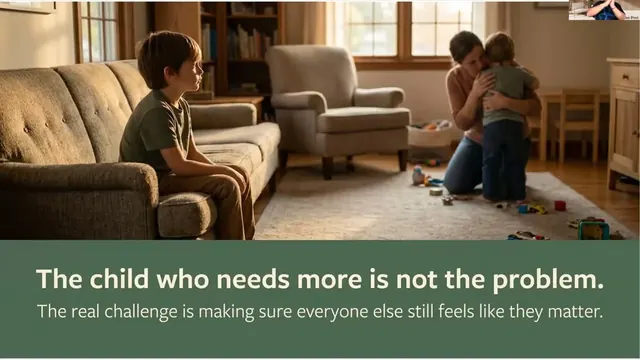
- Why small events create big reactions when your window of tolerance shrinks through the day, and how repeated stress can condition you to see your child as a threat instead of seeing the fear underneath.
- Before you reach out, reach in: take three to ten deep breaths (breathe, slow down, soften), then ask yourself what you are feeling, what you are afraid of and what this brings up in you.
- Not everything that feels good restores you: before reaching for your phone, a drink or TV, try a five-minute state change such as fresh air, a hot shower or deep breaths.
- Build your support system before you need it, and remember that rest isn't abandonment and asking for help isn't failure. Your child needs a present parent, not a perfect one.
Transcript Show full transcript +
0:00Good morning everyone. It's good to see everyone. Surprise. I am not Dr. Alicia. I'm Bryan Post. Dr. Alicia got called away and I am filling in for her. I think it's going to be better anyway. I think you guys are going to be really thrilled to hear today's presentation. So without any further ado, we are right on time. We're going to go probably about an hour. And then if we have some time, we'll open it up for some questions and feel free. Jasmine's in the chat. So if you have questions as we go along, feel free to drop them in the chat. She'll be responding. And I think if I'm not mistaken, Jasmine, at the very end, we'll give a we'll give a link where you can go and get a certificate of completion. This is not a continuing education event, but you can get a certificate of completion.
0:56I know because we have foster parents that need need those hours and sometimes adopted parents. So we'll be able to provide that for you as well. So without any further ado, let's go ahead and get this thing started today. This is such a great topic. I mean, I I was actually pretty excited to be able to share this share this presentation, to be able to step in and do this presentation, just because it's such a cool topic. So let me find my screen here. OK. Do, do, do, do, do, do, do, do, do, do, do. Caring for the caregiver, self care for adopted parents. How cool is that? And this resonates with me at so many, at so many levels
1:53because I was in foster care and I was adopted. And I grew up in a home with two loving, well, well intended parents. They worked extremely hard to provide for us. We never, never needed a single thing. We didn't have a lot, but we had enough. And the idea for them of self care probably didn't even exist. I'm not even sure when that, when that concept became a thing. But both of my parents, even though loving and well intentioned, were both very stressed out because my sister and I had a lot of challenging behaviors. I mean, I wrote a book called The Great Behavior Breakdown and I had probably all of those behaviors. But the thing is, and I stressed my parents out a great deal. I mean, just from, from the very earliest ages.
2:51But the thing is, is my sister, even though she, she didn't have the same behaviors as I did, she, her special makeup of who she was, her past experiences, her history and subsequently her behaviors that manifested from that history actually stressed my parents out even more than my behaviors. My behaviors were, were the overt ones, acting out behaviors. My sister acted in and in and became very immature. She was developmentally delayed. And so where, you know, other 10 year olds played with other 10 year olds. She was still playing with five year olds when she was, you know, 12, 13, she was still playing with nine and 10 year olds. And both of my parents were parentified. So not only were they parentified, meaning for those of you who don't know
3:50what parentified means, that's, that's basically when a child doesn't get to be a child because they have to grow up so fast and very common in the 40s and 50s where parents were working and providing. And the oldest had to care for the youngest. And that was a situation for both my parents. My dad was the oldest, the oldest boy of a sibling group of nine. My mother was the oldest girl of a sibling group of 10. So they were both hyper parentified and which was really in some levels a saving grace for my sister and I, because they were hard working and and very mature and didn't drink and didn't smoke and didn't do a lot of crazy stuff that a lot of parents could tend to do. They were very responsible. But the flip side of that is they were traumatized themselves. But both of my parents were children of alcoholics.
4:47So not only were they children of alcoholics, but they grown up in this really hyper responsible way. My mother's father, when she was nine years old, had a heart attack in front of her at the kitchen table. My father's father was shot in a bar. And so then my father went on to Vietnam and came back from Vietnam with severe post-traumatic stress disorder. And then, you know, they but they worked, you know, they were hyper responsible. But then when you take two hyper responsible parents and you combine them with a developmentally delayed, emotionally regressed, easily amygdally hijacked child, which was my sister because and because they, you know, she was stressed, you stress sensitive. This is this is your children. Your your children are stress sensitive and fearful. And I'm going to say things throughout today's talk and they're going to sound really simple and you're not going to write them down. But when I say them, they can change your lives. If you really spend some time thinking about it and really internalizing it,
5:47then these are life changing. These are life changing sentiments that I'm going to be sharing with you after a career of almost 30 years, working with the most stressed out, most challenging adoptive families, foster families and all kinds of families all around the world. So I've really dialed this in at a very unique level because I was not only born, born, having an understanding of these experiences, but grew up in these fam group in my family, which gives me a different perspective of these experiences and then being able to apply it in all these different settings with all these different families over the course of almost 30 years now. So my father had severe post-traumatic stress disorder. And so then you take not only two highly parentified children, you take two children of emotionally, of alcoholic families, alcoholic fathers. Then what you get are basically emotionally absent parental figures
6:44because they, not because they were bad, but because they'd never learned what that actually felt like in the day to day. And see when we don't have a real actual framework of what emotional presence feels like, when we don't have a real actual framework of even what love feels like, it is really hard for us to then generate that same experience with our children.
7:09So my sister in her immaturity when she'd get stressed, that's what I said moments ago, if you have an adopted child or a foster child, you have a stress sensitive, fearful child, simple, easy, concise game changing, stress sensitive and fearful. Your child is stress sensitive and fearful. And because your child is stress sensitive and fearful, your child will become stressed and that vibration your child sends off. And I'm going to get into this. Well, then stress you out as soon as you become stressed, the impulses from your amygdala drop into your brainstem, dependent on the volume of the stress, the volume of the stress, you know, at a five isn't going to drop all the way into the bottom of the brainstem, which is where all your personality traits are stored, which is where all your, your traumas are stored. So your brainstem, which is your state level of memory holds within
8:06it, your state level of memory, and it stores every memory you've ever experienced. And some of those are preverbal before you actually had words to them, but it stores them as experiences, as energetic experiences in your brain. And then your amygdala goes out and your amygdala is this radar detector. And as soon as your amygdala picks up on some threatening experience in the environment, it sends an impulse into your brainstem, depending on how threatening that, that, that, that's experiences in the environment. It sends an impulse from your amygdala down into your brainstem, down to your state level of memory, looking for a similar memory, looking for a similar energy. And what is emotion? Emotion is energy in motion. So then when that happens, go down in that memory, that energy gets activated and that's when your behaviors manifest the same with your children.
9:04An acting out child is a stressed out child is a regressed child. The same way an acting out child causes a parent to act out, which causes a parent to stress, which causes a parent to regress. That's the real root and base of your fatigue, your overwhelm, your helplessness, your hopelessness. You think it's about these ongoing challenges with your child. But what it's actually about is how the impulses from your brain are perceiving your child's behavior as an attack or as a threat. And then it's going down and it's generating an energy connected. It's opening up an energy connected to a memory of a past experiences of a past experience. It's literally mimicking what you're experiencing in the present. And sometimes this is all preverbal. When's the last time you thought about your actual literal birth,
9:59when your mom and dad, when your mother carried you for nine months, everything she experienced you experiencing, guess what? It's still in your brainstem. It did not go away. It's a preverbal memory. So then what would happen in my family is my sister, who was stressed out and fearful, who had a even much more traumatic birth experience than I did. My my conception, my conception to to seven month in utero stage was really good, really all the way up to nine months, except at seven months. My biological mother knew that she couldn't keep me and everyone else thought that I'd been aborted, but she didn't abort me. She placed me for adoption. So my my in utero experience was really good. My sister, on the other hand, was exposed to to alcohol and a single mom and a mom who potentially lived on the streets. And then my sister was premature, three months premature. She weighed three pounds, three and a half pounds when she was born, and she spent the first three months of her life in an incubator.
10:56So her ability to regulate her stress was more more impacted than my ability to regulate my stress. So my parents, when my sister would become stressed out and start acting out, then my parents would get really stressed out. And when they would get really stressed out and really overwhelmed, the only thing they knew to do was to hit and to yell. I mean, and so so think about you, you take that on a volume knob and you you you hit, you yell at a at a one, two or three volume. You yell louder at a four and then out of five, you start swinging. And my dad didn't give us spankings. He whipped us. And so if if the brain has not has not learned how to regulate stress effectively because it's developmentally impacted, which was which was really the situation with my sister, then she can't recover from stress because it takes 36 hours for the brain to clear high levels of cortisol.
11:56Thirty six hours. And so imagine if it takes 36 hours for the brain to clear high levels of cortisol. Imagine the period of time that it takes for this child to ever be able to recover, much less the child, the parents.
12:15So right now in your home today, when you have a really stressful experience, it's going to take 36 hours, three days before it has cleared the cortisol, the stress from your brain has cleared your body system. Now, how many of you can say that you get to go three days without another episode? Some of you do because you have the right support. You have the right team around you. I mean, that's, you know, a part of why I started LEAF Wraparound and Love Pathways as wraparound programs for at risk families is to give adoptive parents this opportunity for this support and this encouragement, not that you don't still get tired, but that you have support to walk beside you because that's what parents need, parents need support. And this is why I'm so glad you're here. I'm glad you're here because I want to introduce you and welcome you into this community. You know, we do these webinars every month.
13:10I do, I do on Bondify and any of you can go on your Apple Store, your Google Store, whatever, pull up Bondify, B-O-N-D-I-F-Y. Put that in the in the chat, Jasmine. You can pull up Bondify. You can go download Bondify for free. And every Wednesday, I do a live Q&A. So I'll talk, I'll talk on some subject matter for for about 20 minutes. And inevitably, whatever I'm talking about ends up lining up with the question so I can bring it full circle. But I do a live Q&A every single Wednesday. You have the opportunity to get support. And then if you need more than we have resources for you to be able to provide more support, especially if you live in Northern California, Northern Central California. OK, so my parents didn't have that support. This is why I really am excited about this topic. My parents didn't have that support. They didn't know what else to do. So all they knew to do is to yell more and to hit more. And so when I tell you, which we probably won't get into that today about the,
14:09you know, the parenting tools and techniques, when I tell you what doesn't work, I tell you what doesn't work first and foremost from personal experience, not just personal because I've observed it, but personal because I've experienced it. And so there's a reason it doesn't work. And I lay that out very simply. But the problem is simple does not mean easy. So everything I talk about is like a different paradigm. So my parents went, you know, for years, feeling helpless and overwhelmed and exhausted until my sister was 15. My mom said it was so stressful. I wanted to hit your your sister in the head with a hammer because she didn't know what else to do. She didn't know where else to turn. She had no help, no support. So all they knew to do was to do more of what wasn't already wasn't working. And that's usually what we do in stress. In stress and fear and overwhelm, we do more of what's not working.
15:05That is the paradox of stress. It makes us do the exact opposite of what we should be doing. But in reality, that is what you're taught from our culture and from our society. The majority of what you're taught through our culture and our society, when it comes to parenting and when it comes to family relationships is actually the exact opposite of what you should do when stress and fear and overwhelm shows up. But you probably don't have the support network around you to help challenge you enough to be able to learn that there is something different that you can do. And so this is a part of that. So I'm so grateful that you're here because all this comes from very personal experience.
15:47OK, let's get into this. We always ask, what does my child need? Now, I have a tendency to just go on and on and on and try. I'm going to try to be a little bit more dialed in. We always ask, what does my child need in trauma adoption? The caregiver is often the person everyone freaking forgets. Oh, my gosh, who I can already tell, I'm going to be getting wound up today. We always ask, what does my child need? How many times have you took your taking your child to a mental health professional and they take your child away from you and go therapeutize your child and then send them back to you? Did you know, on average, the families we work with have been in? Listen to this, five to seven years of mental health and the children are on three to five different medications.
16:42I recently worked with a mom and a family. Fantastic mom, love this mom, one of my favorite all time mothers. Couple of really tough kids. When I went in to start working with this family and I don't do this very often, I don't hardly do it at all anymore. I have a team that goes in and does this stuff now. But when I went in to work with this family, I, you know, the behaviors were so intense. I said, this doesn't seem normal. This seems like none of it seems normal. But when I say this isn't normal, I'm talking it's way outside of a range of behaviors that I've seen through my career and I've worked with the worst. And so the inability to co-regulate, the inability to just dial down the impulsiveness. I finally said, and this is this is you should know this when I go in and I work with a family.
17:37I don't care what the medications are. I don't care what the diagnosis is. And I'm telling you, this is this is from from almost 30 years of doing this because everyone else, all they've been doing is diagnosing and medicating. That's old paradigm stuff. And you should not change anything based on what I'm telling you. But what I'm telling you is that there is a 97 percent chance that whatever your child is being given is actually not helping. It looks like it is. It may feel like it is sometimes. But if you're if the behaviors continue to be bad, if they continue to stress you out, if you continue to be overwhelmed, guess what? They're not working. But see, then the thought of your child not being on them freaks you out. And so it freaks out the psychiatrist, too. The thought of the child not being on all these meds. Now you got a child on seven meds.
18:32The thought of them being not on them is like, no way, the child couldn't even function. Guess what the child's are. But see, that's why I said stress and fear causes us to do the exact opposite of what we should do. So both these boys were on like eight medications. So first I took them. We did an analysis. We found out what medications were causing symptoms that were being treated by other medications and where the medications were conflicting. No one's doing this for you. No one's doing this for you. So we analyze that, examine that. And then we gave mom a roadmap to take to the psychiatrist to get the boys reducing the medications. And now one of them's, I mean, almost off all of them, I think. And guess what? The behavior is improved. It's not gotten worse. It's gotten it's improved. So now she can continue doing the hard work that she's been doing.
19:27See, we don't think about that because we are too. We are too conditioned to just work on the child. And we forget about the caregiver.
19:38The reason when I work with families and I stopped working with children individually 20 years ago, 25 years ago, you know why? Because stress runs through the entire family, the entire family. And guess whose ultimate responsibility is? And this is a huge responsibility. But guess whose ultimate responsibility it is to create enough regulation in the relationships and in the environments to help the stress subside? It's not the kids. It's us as parents. It's our responsibility. Now I have seven kids. I have three grandkids. So not only have I been doing this for 30 years, I had a lot of kids that challenged and test me every single day. And then I got my beloved grandchildren that I love very much. Here's the thing, your child's stress meets your stress. That is how amygdalas communicate. The amygdala is your fear receptor in the brain.
20:34So when your child is stressed, your child sends a vibration to your amygdala. Now your child's stress drops down into their brainstem and depending on how high the stress ties into some of their oldest experiences and those oldest experiences aren't even that old. They're just intense. Children can't be expected to make sense of the traumatic things that have happened in their lives because they're not old enough. You know, it's, the brain has to reach nine years of age. Listen to this, has to reach nine years of age before it forms the ability for abstract thinking. Before the age of nine, you're not even, you don't even have the ability of abstract thinking. It's just concrete. It's black or white. And we expect children to be able to make sense of their trauma. We do child therapy with a brain that's not even fully able to be abstract
21:29until it's nine years old. How does that make any sense whatsoever? It does not. Your child's stress meets your stress. So your child's amygdala sends a vibration to your amygdala, your amygdala drops down into your brainstem, down into your state level memory and looks for a matching energy. That matching energy is based on experiences that you've lived. It has literally nothing to do with your child. And this is why people say don't take it personally. It's physiologically. It's neurophysiologically impossible to take it personally because your child sends a vibration to your amygdala, which activates your entire nervous system. And when that happens, it is very personal. But what you've got to be able to do is you've got to be able to learn to breathe through that and to realize that in that moment, even though your brain's telling your child's a threat, the behavioral threat, your child is not the threat. The threat is the past story,
22:24the past story of overwhelm, of helplessness, of hopelessness, of terror that you've experienced that's now getting stirred up again. And when that gets stirred up, Joseph LeDoux, New York University neuroscientist wrote a book called The Emotional Brain. He says in times of stress, I'm gonna say this three times because it's so important. So if you don't write it down after this third time, and I'm telling you after almost 30 years of doing this, working with families, high-risk families all around the world, I have an agency of 90 people, two agencies of 90 people. I've written 22 books, sold a million copies of these books. I am an expert at this. I am an expert. I am one of the world's single, single greatest experts when it comes to child behavior and understanding trauma. So if I tell you this and you don't write it down, and at the end of this webinar,
23:20you wonder why you keep struggling, you have no one to blame but yourself. So here we go. Joseph LeDoux, you don't even need to write that down. New York University neuroscientist wrote a book in the 90s called The Emotional Brain. Fantastic book. He says in times of stress, our thinking becomes confused and distorted and our short-term memory is suppressed. And I'm gonna make that really simple. When you are stressed out, you cannot think clearly and you cannot remember. And for children and for adults, we cannot learn. When you are stressed out, you cannot think clearly, you cannot remember and you cannot learn. The stress is the culprit. In times of stress, our thinking becomes confused and distorted and our short-term memory is suppressed. When you are stressed out, you cannot think clearly, you cannot remember and you cannot learn.
24:15A child's dysregulation naturally and biologically activates the caregiver. You aren't failing. Your nervous system is functioning as designed. You're not doing anything wrong. You're not doing anything wrong. You've just not been supported in the mechanisms to help navigate through the hard situations. So then the hard situations mount up and before long, you feel completely helpless. Like you're like, it's all your fault. You're not alone. You're not alone. How many people are on here? We had 185 people register. We got 72 people on here. When 185 people register, we have 72 people on here. You're not alone. There are a whole lot of parents on this webinar today that feel the exact same way you do. And there are a whole lot of professionals who want to learn how to have even more impact than they're already having. So the child's dysregulation naturally and biologically activates the caregiver.
25:11The child's stress stresses you out. That is natural. It's the vibrations of the amygdala. You aren't failing. That's what your amygdala is supposed to do. Your nervous system is functioning as designed. That is how we were designed. We were designed when we see the saber-toothed tiger, we're supposed to go into fight, flight, or freeze. And I don't say fawn because I think that's, I don't like that. I think that's too much like freeze. But recently I heard someone say instead of fight, flight, or freeze, now it's fight, flight, freeze, or video. Oh, I was like, or film. Fight, flight, freeze, or film. Isn't that the weirdest thing? Isn't that the weirdest thing? So fight, flight, and freeze are defense mechanisms. They're survival mechanisms. Isn't it the weirdest thing that with all the social conditioning and the dopamine of cell phones
26:06that now our natural reaction, reaction, not even response is to start filming as though that's gonna keep us safe. That is so fascinating. It's so fascinating. The milk isn't the problem the shrinking window is. See, this is good. This is really good. This is really good. Jasmine designed these for me using notebook, NotebookLM. This is fantastic. The milk isn't the problem the shrinking window is. The problem, the bigger problem though is that our amygdala looks at the milk, ignores the shrinking window of tolerance and then gets pissed off and stressed out because of the milk. It ain't about the milk. It's about the shrinking window of tolerance. Our capacity for stress decreases and stress accumulates throughout the day. Small events create big reactions when the nervous system is already overloaded.
27:02Man, is this good? Yes or yes? Are you feeling me? I have a sense that you all are really feeling me today. I get that reciprocal kind of energetic experience when I feel like the people who listen to me are like, yeah, yeah, yeah, yeah. Every now and then I get some resistance. I feel it in my ears. I get a little sound. I just know someone's being resistant and that's okay. That's okay. It's okay to be resistant. That's natural actually because number one, all this stuff goes in the face of what you've been conditioned to think. So it just creates conflict. See conflict is where you have growth. You have to have conflict in order to grow. You gotta be challenged. So what you do with that is you breathe,
27:58which is the most important thing that any of you can do in any relationship is learn how to breathe in the midst of stress. So your child starts regulated and I always use the analogy of the window of tolerance. And then there's the morning and this could be for you too. And then there's the work and then there's a school call and then there's the bills and then there's the traffic and then there's the deployment. And guess how much window of tolerance you have to be able to now regulate and navigate stress with the most important people in your life. I always say we spend the majority of our window of tolerance on the people and the things that matter the least. And then for the people who matter the most, we have the least ability to regulate stress.
28:40Attachment is the dyadic regulation of stress. Attachment, secure attachment is the ability of two people to regulate stress together. So when two histories collide, guess what, you have a history. We all have a history. Your history could actually be more traumatic than your child's history, but because you're 40 or 45 or 50, you've not ever had an opportunity to really focus on it and look at it and think about it. No one's created the environment for you that you're trying to create for your child. Who in your life, do a quick poll, who in your life showed up for a webinar or a training in order to be better for you? Crickets, chirp, chirp, chirp, chirp. You know, that makes me sad. It makes me sad because it wasn't about you. They were too busy trying to survive.
29:37We're all doing the best we can in any given moment. But you know why they didn't? Because you were perfectly wired and created to be right here today for the child that you have in your home. If anything else had been different, everything would have been different, but it wasn't. And so now you're learning how to be in some different space for your child that no one provided for you. Or maybe you had one influential person who was able to do that. Your child's trigger can become your trigger. Don't see the behavior, see the fear underneath it. Such a simple statement. Such a simple statement. Such a simple statement. Such a simple statement. I've been saying for 25 years. For 25 years, ignore the behavior. Don't ignore the child. Ignore the behavior. Don't ignore the child. But you know why it's so hard for us to ignore the behavior? Because the moment we see the behavior,
30:33our amygdala perceives it as a threat. When your amygdala perceives it as a threat, it hijacks your brain. It hijacks your brain. It hijacks your emotions. So it starts pumping out the cortisol. And then what did I say? In times of stress, your thinking becomes confusing, distorted, your short-term memory suppress. So the moment you look at your child's behavior and you see the behavior, you perceive it as a threat. When you perceive it as a threat, it goes into your brain stem looking for a similar experience and then sends you into survival. Now pretty soon, pretty soon, you're in a constant state of survival with your child and that becomes the conditioned state.
31:15Bruce Perry says, there are two ways to change the brain. Repetition and emotional impact. And it's not just the brain. It's the entire nervous system. It's not just the brain. You say, it's not just the brain. It's the body, mind. There's no separation. It's the body, mind. Whatever happens in the brain happens in the gut and vice versa happens in the heart. It happens all over. It's all at one thing. But emotional impact and repetition is how we change our synaptic connections. Emotional impact and repetition. Now some of you are having negative repetition and negative emotional impact every single day and you're not getting a break and you are exhausted. And so then what happens over time is you get conditioned. Your amygdala gets conditioned. Oh, you're not gonna wanna hear this, but you have to hear this. And it's really sad. It is so sad. You get conditioned to see your child as a threat.
32:12And when you get conditioned to see your child as a threat, you're really everything about you changes when it comes to that child. Now I gave you this story at the beginning of this webinar about my parents. Let me tell you something about my life. I grew up in a little town, 2,000 people in Mountain View, Oklahoma, where ever I turned, I had a positive experience, even though I had all those negative behaviors. Even though my dad yelled, he whipped, he shamed, he did all this stuff. My mom did the best she could with all that too. She tried her best to still whip when dad wasn't there, but pretty soon I got big enough that I took the belt from her one day. And then that was really the last whipping I got. I mean, it's like, we're not gonna keep doing this. You know, I was like 12 years old. Already taller than her. It's so funny. I'm gonna have to remind her of that story.
33:07My dad passed away 22 years ago, but my mom, I still, I love and adore, she's my biggest fan. I'm gonna have to remind her of that day I took the belt from her. I still can see it in my brain. Regardless of that, I knew my parents loved me. I knew they supported me. I went to school, I had a lot of friends. Teachers loved me. I was a good athlete, so I was popular. Everyone in the town knew me. So everywhere I looked, it was positive. Like I had no anxiety about this little world we lived in. It was fantastic. It was my saving grace. But one of the things my biological mother told me, as I'm telling you this story, I want you all to be reflecting on your own, on your own childhoods, on your own and your experiences. Because that's what's getting stirred up right now that's causing all this stress for you and causing all this fatigue and overwhelm. Because you have these painful experiences that you've not been able to grieve. And when you can't grieve a painful experience,
34:04it stays with you, sometimes your entire life. So then it starts getting activated by your child and you think it's your child, but it's not. It's what's getting activated within you that has not been grieved. And that makes me very sad as I talk about it. But everywhere I looked, it was very positive. My sister, on the other hand, everywhere she looked, it was negative. From conception forward, everywhere she looked was negative. Give you an example. My mom said, when we got you from the social worker, you were smiling, when we got your sister, she was crying. That just defines everything. And that's how it remained until she, at 15, she left home. She didn't run away, she left home because she got tired of getting whipped. But at 15, you're not getting whipped anymore. It's called a fight. That's called a fight. She got tired of fighting with my parents. So she left home. And that was the most peaceful. That was the most peaceful couple of years.
34:59From, for me, I was 16. I went to college when I was 17. That was the most peaceful period of time I had experienced in my entire life. It was quiet all of a sudden. But what had happened is over the course of those 15 years, my parents had become conditioned to see my child as a threat. And I talked to parents all the time about this. All the time, when you've gone through stress enough, pretty soon your child becomes the threat. And when your child becomes the threat, when you see your child, your nervous system has a negative reaction. Love goes away, fear replaces it. And when you look at your child and you experience fear instead of love, then you're sending them a fearful vibration. They pick up on that vibration without anyone saying a thing. We have an emotional thought field.
35:56We all have an emotional thought field and it's the field that we create from the vibration within our being that communicates. And it expands out 10 to 15 feet, 10 to 15 feet. So when parents get locked into this negative cycle, then the communication, even on the good days, even on the good days, is quickly disrupted by that conditioned experience. So all of this stuff I'm talking about is not just about changing behaviors. It's not just about giving you a respite day. It's about helping you recondition your brain. And I am saying a lot in a very short period of time.
36:37Before you reach out, reach in, now let's dig into it. Here's what my parents needed to hear, but no one ever told them. And I thank God for that because I wouldn't be here today if that was the case and I wouldn't have been conditioned to become the person that I am to help change and impact a lot of lives in this lifetime. Before you reach out, reach in, the most important thing that I teach parents to do and professionals, that's a whole not, that's a whole nother conversation. But I'm gonna tell you really quick, as a professional, you can't help others achieve what you cannot achieve yourself. So if a parent is looking at a child's behavior and getting stressed out and that behavior is causing you to feel stressed also, then you can't help the parent feel regulated enough to create the environment and the relationship to help the child to feel regulated
37:33and safe enough to work through the behaviors. It is very simple, it is very simple, and it is so difficult. Before you reach out, you have to reach in and what is reaching in? Reaching in is stopping and taking three to 10 deep breaths. This is not a, it would be nice to do, this is a you must do it, you must do it. When you get stressed, you have got to train your brain to stop and take three to 10 deep breaths. Because remember, if you don't, your amygdala is going to hijack your brain and all that's gonna do is create more of a negative feedback. So you ask yourself, you stop. So I say, I call it BSS, breathe. The first thing you have to do is breathe.
38:29Second thing you have to do is slow down. The third thing you have to do is soften. Breathe, slow down, soften. And you can do this today. See there's nothing, there's absolutely nothing I teach that you can't do today, that you can't practice in this moment. We can breathe right now. That is the single most important thing, the most important skill you can learn that will benefit you for the rest of your life. Practice it. And remember, as soon as you get stressed, the first thing you're gonna do is automatically, you're gonna start holding your breath and start taking very short, ineffective breaths. So you've got to be able to interrupt that. You've got to be able to step in. When you stress, which is automatic, you've got to condition your brain. Bam, stress, breathe. Because if you don't, if you don't interject with the breath, then the cortisol hits your hippocampus,
39:25shuts down your hypothalamus and sends that confused and distorted message to your prefrontal cortex. And that drives your behaviors. And before you can teach your child to do it, you've got to be able to do it yourself. Oh my gosh. Oh, I say this is not rocket science, but it is brain science. It's so simple, but it's so difficult. You know why it's difficult? It's difficult because the moment you see your child's behavior, sometimes it's not even your behavior. Now remember, if you're conditioned, the moment you see your child, you get stressed, cortisol activates because your nervous system has got negatively conditioned. We've got to interrupt that. We've got to, we can't keep it. We can't create a healing environment or a healing relationship. If every time you look at your child, you feel stressed or you feel scared.
40:21And no one can tell you if you feel stressed or scared except for yourself. And if you're not willing to take an honest accounting, nothing's going to change. Nothing's going to change. So you've got to breathe. You ask yourself, what am I feeling? You ask yourself, what am I afraid of? And then you ask yourself, what's this bringing up in me? And listen to me, listen to me. As long as your child is not at risk of killing you, killing themselves or killing someone else, you 100% can do this. If they're yelling, screaming, falling out, kicking the wall, threatening to run away, you've got time to do this. And this takes minutes. It doesn't even take minutes, it takes seconds. And then when you breathe, when you slow down and when you soften, you can start engaging from a more conscious, a more cognitively dialed in, a more loving presence.
41:18But it starts here, it's so important.
41:21Stress is so contagious, but so is calm. A regulated caregiver creates a safer environment, emotional environment, your regulation changes the actual emotional atmosphere of the room. Now, here's what I want you to know. The definition of emotion is energy in motion. The definition, you can look it up. The definition of emotion is energy in motion. So when, look at the vibrations here. Look at the vibrations. When it says, stress is contagious, but so is calm, then look at what the parent is sending off to the stressed out child. This is such a good slide. But imagine if the parent was equally angry or the parent was equally shut down, then guess what the vibration would look like? It would be a stress vibration.
42:17Hey, Jasmine, we should have it, we should have, I would love, see, this reminds me of my negative and feedback, this is so funny. I've been doing this for so long. This reminds me of my negative and my positive feedback loop slides. And they used to be stick people, like the old ones used to be stick people. In fact, on my, on my Bondify weekly Q and A's, I've been going back and finding some of my old slides and pulling them forward because it's all the same information. But my, this is, this is the very definition of a negative positive feedback loop. A negative feedback loop cannot grow in the midst of a positive one. So I'd love, I'd love Jasmine if we could create another one that's negative, that's just negative. So the parents anger and send it off the negative vibe and the kids, the kids just in that place. That'd be, that'd be beautiful. But this is what's so important.
43:12Now look at the parent here, doesn't, when you look at the parent, doesn't, doesn't he send you a positive vibe, just a picture? This is what's happening in your home, in your relationship with your child, in your relationship with your spouse. This can even be happening in your job. This is human behavior. This is not just about adoption parenting. Everything I teach is about human behavior. If you're creating a negative feedback loop, you're just generating more negativity. It is not difficult. If you're stressed out and scared, but you're not conscious enough or mindful enough to know you're stressed out and scared, you're feeding into the negative feedback loop and then wondering why you keep seeing the negative or why you keep getting negative back. You keep getting negative back because you're feeding the negativity. It's very simple. A negative feedback loop cannot grow in the midst of a positive feedback loop.
44:07It just can't. Sometimes the best thing you have to do is nothing at all. If you can't stop talking, if you can't stop threatening, if you can't stop shaming, do nothing at all. Breathe, breathe, soften, slow down, soften. I'm so happy that Jasmine only created 16 slides. Sometimes I have like 45 slides and I'm like, bam, bam, bam, she's finally learning me. Breathe, am I calm? Am I calm? This is the essence of self-care, folks. You're waiting for me to give you these specific things, but you're missing the point. This is the point. These are the things that make the specific things possible. Listen to this. If you cannot breathe, you cannot interrupt
45:03your confusing, distorted thinking and your suppressed short-term memory. You have to be able to breathe. Breathing is how you turn on oxytocin. You have to be able to, oxytocin is your brain's anti-stress hormone. It's the hormone that makes love possible. You've got to be willing to breathe because this is what's gonna give you access to all the other things that I'm teaching. But I can teach you 100 different tools and techniques, but if you get stressed out and your thinking becomes confusing, distorted and your short-term memory suppressed, you won't remember a single one of them. I want to teach you one valuable thing and I want you to do it today. And this is how you give the care back to the caregiver. This is how I give you back your power and I have the ability to do that. I have the ability to infuse you
45:59with more power than you ever realized. And here's how you do it. When your child starts acting out today, I want you to stop. I want you to get quiet and I just want you to breathe. And as you're breathing, I want you to observe yourself and I want you to observe your child. That's all I want you to do. It is so simple, but it is profound. I don't want you to do anything else. I just want you to do that. And then pop on the live Q&A tomorrow and we'll talk about it.
46:33Not everything that feels good restores you. This is a great slide too. Look at this. Look at this. Cell phones and alcohol. And I tell you, I love my cell phone and I love a good glass of whiskey and I love to sit down and mindlessly disassociate by watching some kind of violent, goofy show on television. But guess what these things do? They don't lend themselves to your restoration. They give you a distraction, but the very distraction is causing cortisol in your brain and your body system. It's just a distraction. If you want real, genuine restoration, now look at the difference. We've got the boots, which means go for a hike, go for a walk, walk out in the driveway, walk out in the yard, get some fresh air, look up at the sun, tilt your head back, breathe in, take a hot shower,
47:30take some moments for yourself, take a hot shower, relax yourself, lay in the bed, let the fan blow over you, take five to 10, 20 deep breaths. You might not have time to go all the way into this for an hour. We're not talking about an hour. You need five good minutes. And then get up in the morning and enjoy yourself a nice tea, a nice coffee. See, coffee can create anxiety and cortisol for some people, so you got to be aware of that. But it's the hot liquid. It's the hot liquid, which soothes not only your brain, not only does it relax your heart, but it relaxes your gut. See, you got three brains. You got a brain in your head, you have a brain in your heart, and you have a gut brain. So a nice hot liquid in the morning when it's quiet is soothing. So ask yourself, does this activity actually restore my nervous system?
48:26And I'm not telling you you can't look at your phone. I'm not telling you you can't have a glass of wine, or in my case, a nice whiskey. I'm not telling you that you can't watch television. What I'm telling you is that you've got to be aware of what's actually restoring you versus what's not. And sometimes you can be under so much stress that the only thing you want to do is just get distracted. But if you want to do something different, you have to be someone different. So instead of before, instead of, instead of staying instead of, before you pick up the phone or you pour the glass of wine or you go watch television, go outside and get some fresh air. Do 10 push-ups. Go lay in your bed, flat on your back, and close your eyes and just breathe. And then you come back and then you do these things if that's what you need to do. So what can change your state in five minutes? See, this is important.
49:21We're not, listen, I'm not, everyone wants a respite. And I love respite for parents. I truly do. But what I also believe in is a respite for the child. And that's one of the foundations of what we started when we started LEAF Wraparound and Love Pathways is that when we first, very first started, we created respite. But when we created respite for the parents, the child also got a respite, because you know what I know? I know it's about nervous systems. I wanna relax you and help you recover and restore, but I also have to help your child relax and recover and restore. And then I bring you back together. So that's great if you can get it, but we're just talking five minutes at a time. We got a shower, we got some music. I'm not sure what this thing down here, maybe a nap, maybe that's a blanket, I'm not sure. We've got some exercise, we got a hike, we got a nice hot chocolate, a nice coffee.
50:17The goal isn't a spa weekend, the goal is a rapid state change when your window of tolerance begins to shrink. Because as you get stressed, your window of tolerance is getting smaller, you don't have to run away. Just stop and breathe. Go fix yourself fatigue. Yes, the problem will be there five minutes later. You're fussing with your child and your child gets mad, y'all are yelling and they run and they slam the door to their room, don't follow them. Be thankful that now they're in their room and you don't have to deal with them. Sit on the couch, have a snack, do some deep breathing, maybe read a few pages of a book, maybe do some journaling, do something that's really going to interrupt your state level stress. And then you can do those other things because in that five minutes you can actually restore your window of tolerance. In that five minutes you can restore your window of tolerance.
51:12It's the same thing I talk about when I talk about with parents about observing what your child's window of tolerance is and interrupt before they hit the bottom of that window.
51:23Don't build the fire escape while the house is burning. Create your caregiver support system before you desperately need it. You cannot wait for the crisis to figure out who is going to help you. This is so important. Get your support, build your support, before the house catches fire. Be preventative. We are so stressed and we're oftentimes so interventive. When nothing's happening, we're like hiding out, hiding out in hopes that it's not going to change it. Everything's going to be okay. Don't do that. Go check in, go give a hug, go ask a question, go get involved. So you got to get yourself right first and then you go check in. That way you're not waiting until there's a crisis. So ask yourself daily, what keeps me grounded? What can you do that's going to keep you grounded? You know what you can do?
52:18You can take your shoes and your socks off and you can go stand in your grass and you can take five to 10 deep breaths and you go put those shoes back on, little socks, put those shoes back on and then you jump back in there. You can do that if that feels good to you. Weekly, what replenishes you? In relational, who can I be completely honest with? Who can I just talk to? Who can I share my stress with? And here's what I want to remind you of. Here's what I want to caution you of. You know you're going to bar, everyone is drinking so you set up at the bar and you have a drink for those of you who do that. Guess what, everyone's drinking. You know when you talk to a negative friend and there'll be a negative and they're complaining? It doesn't take long for you to become negative and for you to start complaining. When you're sharing, don't just share the negative things
53:13and don't just let your amygdala focus the negativity on your child. Share what you feel. Share what you feel internally. Like share your sadness, share your anger, share your overwhelm and then you take a deep breath and you ask yourself, when have I felt this way before? And now share that. Make the connections to why you're feeling what you're feeling and process that and create space for you to be able to grieve. See, we don't have a lot of space to grieve. See, that's the best relational support. The best relational support doesn't just jump in and tell you, oh my God, they're terrible. Your child's terrible. Oh my God, you're so great for putting up with all this b******t. That's not great relational support. Great relational support is holding presence for you and listening and not trying to solve.
54:09Just listening and telling you that you're okay to let it out. And then who are you gonna call when you've reached your limit? Cause we all reach our limit sometimes. We all reach our limit sometimes. So who are you gonna call? Build the fire escape before the fire so you get your emergency support. You have your relational support. You have your weekly restoration and then you have your daily support. You are allowed to have needs. Rest isn't abandonment and a boundary isn't rejection and asking for help isn't failure. Your rest does not mean you're abandoning your child. See, I don't believe in giving children timeouts. I believe in giving children time-ins because children don't act out for attention, children act out because they need attention. But here's what I'll tell you. You can give yourself a timeout. You can say to your child, you know what? I am really stressed out right now. I'm really overwhelmed. I'm gonna go give myself 10 minutes in my room
55:04so I don't pinch your little head off because if I keep standing here, I'm probably gonna say something that's gonna really make you sad or really make you angry or really scare you because I'm feeling really violent right now and I love you but I'm not feeling that way right now. So I'm gonna go in my room and give myself 10 minutes and I'm gonna give you 10 minutes and then I'll be back, I promise. You have the ability to be able to say that. You can say that and you can take the 10 minutes and if they follow you and they're still beating on the door, take some deep breaths, open the door, let them in because they're just scared. They're just scared. Invite them onto the bed, ask them if they need a hug, you keep your eyes closed, you keep breathing, you have faith that you're gonna be okay and you keep working on yourself. Having a boundary isn't rejection, even though that's how your child may perceive it, it is okay to have the boundary and it is okay for them to feel rejected
55:59and asking for help isn't a failure. Ask for help, reach out, there are supports that are available.
56:07Your child doesn't need a perfect parent, they need a present parent. They don't need a perfect parent, they need a present parent. It's not about quantity, it's about quality. How much quality can you get in those moments? None of us are perfect, we all mess up and the best thing you can do after you mess up and I love it, I love messing up because when you mess up and you've had just a really stressful time, you can always, after it's done, you can ask yourself, here's what I want you to do, I want you to look in the mirror and I want you to ask yourself, what could I have done better? And I want you to look in the mirror and I want you to ask yourself honestly and authentically how are you feeling? And then you ask yourself honestly and authentically when have I felt this way before? You see what I'm asking you to do? I'm asking you to do the things that are very hard but these are the things that actually
57:03create the building blocks of self-care. This is how you're really taking care of yourself by getting really honest with yourself and giving yourself permission to have your feelings and giving yourself permission to grieve and then you get back in it because parenting doesn't end at 18. A lot of times it's just starting there. The goal isn't perfection, the goal is presence, awareness, regulation and repair. Your regulation is part of their healing. When you care for the caregiver, you change the emotional environment, the child is healing inside of, the person doing the healing work matters too. My goodness, my goodness, if I could just put the biggest blessing on top of all of you right now in this moment. If I could just put the biggest blessing right on top of you, right on top of your head so it could just run down through your body. If I could just send this vibration of light
57:59and love to every single one of you right now. And just to tell you and let you know that you are valuable and you are important and you are good enough and you are not failing and there is hope, there is hope, there is hope and you got this and you are perfect for this. You are just in a season of growth. All of these challenges are about growth. This feeling of helplessness is about growth. You are growing, you are growing, you are growing and as you grow, your children grow too. You have to walk through the door so they can follow you and you have it within you to be able to do. You have every resource you need, right within your brain and within your heart, within your own experiences. It all starts with your ability to stop and breathe and slow down and be gentle with yourself.
58:57Stop beating yourself up. You want to beat yourself up because you think you're doing it wrong but you're not, you're just on the journey. Healing is a process. It is not a destination, it's not an outcome. It is a process. It is a journey. All the growth that you do is benefiting your child. You showing up and being here with me, being here with me during this period of time, it's benefiting your child. You might not know it, but your cellular system is shaping, it's restructuring, it's regenerating, it's gonna benefit you, it's gonna benefit your child. You have the power within you and it all starts with breathing. It all starts with breathing. Okay, here's what I want you to do. You can go to feartolove.com or you can, if you're on your laptop and you have your phone, you can snap, take a snapshot here.
59:52You go to feartolove.com forward slash pathway finder and we have created this little AI system that it'll ask you some questions and as you put in the answers, it is going to be listening to what it is that you need that would put you on the best possible journey to get to the goals that you want and all you gotta do is go to feartolove.com forward slash pathway finder. There's nothing to sell on this webinar. The only thing we do is we provide education, we provide encouragement, inspiration and support and this is for everybody. So all of you can go to feartolove.com and it takes you three minutes to do, this is something Jasmine put together, takes you three minutes to do and it's gonna give you a direction. It's gonna give you a direction to pursue and again, every single one of you has access to Bondify, it is a free resource,
1:00:48it's probably gonna tell you Bondify but Bondify is a free resource where you can ask me questions, we have a community there, you can ask to just click on the little Bryan icon, it's gonna say hey, how are you doing and you just give it as much information as you possibly can and then every single Wednesday, the real Bryan Post is showing up doing a live Q and A tomorrow morning, nine o'clock Central Standard Time, 7 a.m. Pacific Standard Time, 10 o'clock Eastern Standard Time and I'll be answering questions, providing as much support, as much guidance, as much encouragement as I possibly can. Together, together we can get through the most challenging times we can do it. God bless each and every one of you, I'm gonna stop the share. And Jasmine, I'm gonna take about five, 10 minutes,
1:01:45do we have any pertinent questions? I haven't seen any questions yet. Okay, fantastic, does anyone have any questions? You can, there is a way to raise your hand but I'm not sure how, but you can do that but if there are no questions, we're just gonna wrap it up.
1:02:04Oh wait, Bryan, I think we had one on the medical analysis, they were just curious as to kind of how you would get that medicine, sorry, the medication analysis that you talked about in the beginning. Send Jasmine an email to support@feartolove.com and we will direct you in that process. So that's support@feartolove.com And Jasmine, did you also drop the link for the certificate if you could drop that in there?
1:02:41A participant has a question, go ahead. Yeah, Bryan, my question is I love the way the third step which was soften. How do we soften when we've never ourselves been taught to soften or had a mother who's softened? Such a good question. I appreciate that. So when I say you breathe, you breathe, you take your three to 10 deep breaths and you slow down. So what's happening in those two stages between the breathing and the slowing down is you're getting out of survival mode. You're getting out of survival mode and you gotta get out of survival mode, which is fear-driven in order to access love. See, this is critical. Because love and fear cannot coexist. So when you are breathing and when you are slowing down,
1:03:36the next thing I want you to do is I want you to put your hands on your heart and I just want you to ask yourself, how am I feeling right now? And you just hold that space. You just hold that space. And then you say, when have I felt this way before? And you just stay right in that space until that little girl shows up. And when that little girl shows up, just be there with her for a moment. Just be there with them for a moment. And then honor whatever that feeling is that comes up. You do that first for yourself. You honor that feeling and then you look at your child and you go through the same process. What must she be feeling? When has she felt that way before and wait for that little, wait for years to be able to see that little girl or that little boy, whatever it is, or that little boy, whatever your child may be. For you, I think it's a little girl.
1:04:31See that little girl. And then just hold that space for that little girl. And really what it's doing, it's just bringing you into the present moment because stress causes us to react from the past, obsess about the future, but it takes us out of the present. And the present is the only moment that exists. It's the only moment that exists. Thank you for that question. That's beautiful. Yes, can you hear me? I can hear you. Okay. Mine is not along those lines. I just wanted to see if I could have a one-on-one with you in your office. I have, mine is more business guided because I'm gonna be moving and I wanna get a little bit of advice from you because I'm not an adopted parent or anything, but I know caregivers are caregivers regardless
1:05:26and I am a social worker. So I just wanted to talk to you, pick your brain and get some information from you on another level at another time, if possible. We can do that. Just send me an email. Send me an email. I'm gonna give you my email address. [personal email address removed] That's my email, my personal email. So shoot me an email and we'll set up some time to talk. Okay. Thank you, Bryan. You bet, you bet. Wonderful, wonderful presentation. Loved it. Thank you so much. Thank you so much.
1:06:02I seen one little thing there from a, [A grandparent raising their grandson asks:] What is your suggestion on how to rid resentment against his mother, our daughter for abandoning her son? Oh, oh, oh, oh, oh, oh, oh, oh, oh, oh. Man, I love it when I get those good, deep questions that just like squeeze my heart. Oh my goodness. Whoo. So what we're talking about, my friend, is we're talking about unexpressed grief. That's what we're talking about. Here's what I'm gonna ask you to do. I'm gonna make this quick because it doesn't take, it's gonna, the real work is really on you. What is it in your daughter's life that you can take responsibility for? If there was any one, two, three things that you could apologize to her for,
1:06:57or you let her down, or you could have done something different when she was growing up, or any time, what one or two or three things can you take responsibility for? And then when you take responsibility for, can you allow yourself to grieve not being able to be who she needed in that time? That's number one. Number two, stop seeing a child or stop seeing an adult who is just not being responsible because that's who you're looking at and that's why you're feeling resentful. See a child who is overwhelmed, doing the best she can, but is in a place she can't crawl out of, grieve for that child. Grieve for that child. So instead of seeing her as an adult, see her as a child and you are a,
1:07:52it showed up right then, she's nine. See her at nine. See her at nine, whatever happened at nine. See her at nine and grieve for that nine-year-old. And when you grieve for that nine-year-old, when you do what, when I said the first part, take responsibility for something, forgive yourself for that, grieve that, forgive yourself for it. Number two, see her, see the child and not the adult, grieve that, the resentment will go away. It'll start dissipating. It may go away immediately, but when you can make that connection to the child part of her instead of the adult part of her, the resentment will start to diminish. And thank you for asking the question. It's a fantastic question because it takes a lot of courage to ask a question like that. So God bless you. God bless every single one of you. God bless you, may God bless you. And I hope this has been helpful. I wanna thank you for showing up here. Stay connected to our community
1:08:48because we do these webinars all the time. You'll get invitations for other webinars because all we wanna do is we wanna educate, we wanna support and I hope you have a fantastic day. We'll see you guys soon.